Project Overview
Nord Welding & Engineering AS (NWE) carried out a comprehensive structural stress analysis and lifetime assessment of a 48/6T double-girder gantry crane operating in a marine environment after more than 20 years of continuous service. Due to long-term exposure to cyclic loading, corrosion, and environmental effects, a detailed reassessment was required to verify structural integrity, confirm operational limits, and establish a safe and technically justified life extension strategy.
The assessment was conducted to support continued operation while maintaining compliance with applicable engineering standards and safety requirements.
Quick Scope (at a glance)
- Asset: 48/6T double-girder gantry crane
- Environment: Marine service (corrosion + cyclic loading)
- Core work: FEM/FEA stress verification + fatigue (S–N) + corrosion impact → FFS basis
- Outcome: Remaining life estimate + strengthening, corrosion protection, and inspection/monitoring recommendations
Project Objectives
The primary objectives of the project were to:
- Verify the Safe Working Load (SWL) under current structural conditions
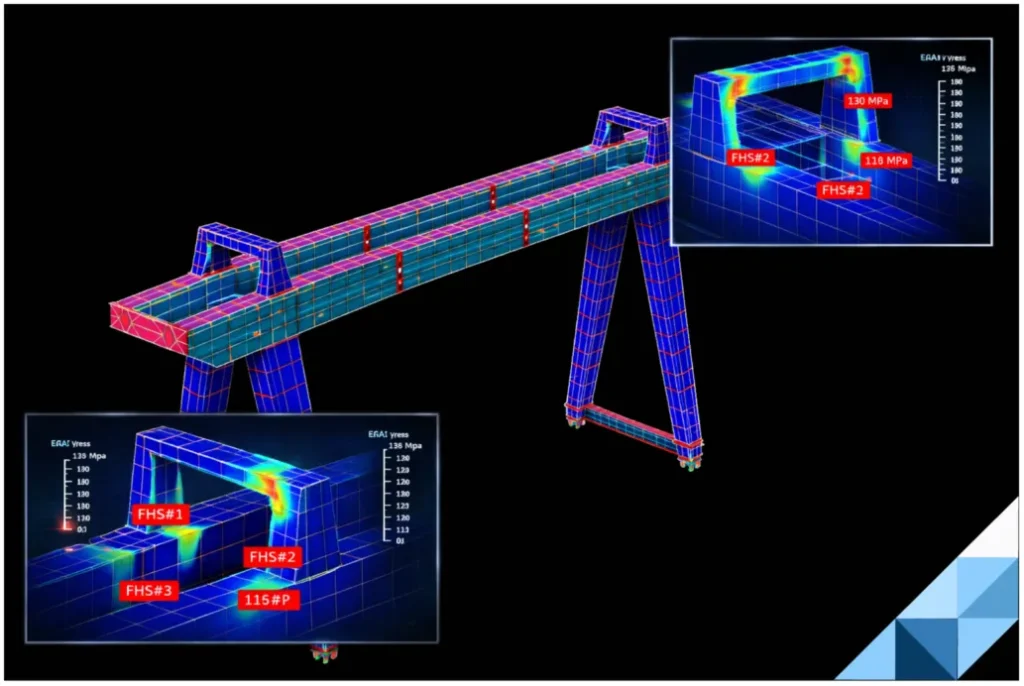
- Identify stress concentration zones and fatigue-critical details
- Quantify accumulated fatigue damage and estimate remaining service life
- Evaluate the impact of corrosion and material degradation
- Develop engineering recommendations for strengthening, repair, and monitoring
Engineering Methodology
Data Review and Digital Modeling
- Review of available inspection reports, structural drawings, and maintenance records
- Integration of corrosion mapping data into a three-dimensional structural model
- Development of a detailed Finite Element Model (FEM) with more than 80,000 refined mesh elements
Structural Stress Analysis
- Structural analysis performed in accordance with FEM 1.001 and relevant EN standards
- Nonlinear second-order analysis (P-Delta effects) to capture geometric nonlinearity
- Load cases included self-weight, dynamic crane effects, horizontal accelerations, and in-service wind loads
Fatigue, Corrosion, and Fitness-for-Service Assessment
Fatigue Analysis
- Fatigue life assessment performed using ANSYS Workbench
- S–N curve methodology applied with Goodman mean stress correction
- Cumulative fatigue damage calculated for critical structural members
Corrosion Impact Evaluation
- General corrosion losses in the range of 1–3%
- Localized pitting observed in limited areas
- Estimated fatigue life reduction of 25–40% in fatigue-sensitive zones
- No active cracking detected through ultrasonic testing, eddy current inspection, or visual examination
Related service: for projects requiring qualified NDT support, see
Advanced & Conventional NDT and
In-service inspection.
Key Results
- Maximum deflections and stresses remained within allowable limits
- Critical fatigue zones identified at upper girder plates and connection stiffeners
- Adequate safety margins confirmed against material yield strength
Outcome and Recommendations
The gantry crane was determined to be structurally stable and fit for continued operation under controlled conditions. A minimum remaining service life of 10 additional years was established, subject to implementation of recommended operational limitations, targeted strengthening, corrosion protection, and periodic inspection and monitoring.
Relevant NWE service pages:
Asset Integrity Management
Structure Stress Analysis
Fitness-for-Service (FFS)
Inspection Services
Interested in a similar assessment for aging cranes or lifting structures?
We support remaining life, fatigue hotspots, and fit-for-service decisions as part of Asset Integrity Management.
 Contact NWE to discuss your case
 +47-40221100