
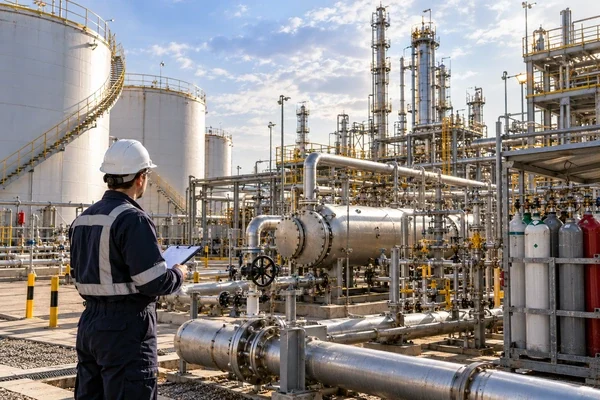

From 1 January 2027, the equipment and installations listed in Section 9, second paragraph, a–j require accredited installation inspection before operation and accredited systematic condition inspection in service. The categories come from FOR-2026-02-04-140, read with its subsequent amendment FOR-2026-02-20-244.
The broader duty to arrange systematic condition inspection and the requirement to use an accredited body are separate questions. An installation outside a–j is not automatically exempt from the general inspection duty. Screen the actual equipment, substance classification and system boundary, rather than the business sector alone.
The ten categories in Section 9
The table summarises the adopted categories effective 1 January 2027. English category labels are explanatory translations; the Norwegian legal text is authoritative. Hazardous substance is used in the regulation’s sense, not as a description of every chemical.
| Category | Equipment or installation covered |
|---|---|
| a — Boilers | Boilers intended to produce steam or hot water above 110°C, where pressure in bar multiplied by volume in litres exceeds 3,000, pressure exceeds 0.5 bar gauge, and volume exceeds 100 litres. These conditions apply together. |
| b — Gas consumption installations | Installations containing more than 400 litres of toxic gas, categories 1, 2 or 3; and installations using flammable gas, categories 1A, 1B or 2, connected to a tank, distribution pipeline or cylinder battery. The specific exceptions below must also be considered. |
| c — Refrigeration and heat pumps | Refrigeration or heat-pump installations containing 400 litres or more of flammable gas, categories 1A, 1B or 2, or toxic gas, categories 1, 2 or 3. |
| d — Gas filling installations | Filling installations for flammable gas, categories 1A, 1B or 2, or toxic gas, categories 1, 2 or 3. |
| e — Gas fuel installations | Fuel installations for flammable gas, categories 1A, 1B or 2. |
| f — Gas tank installations | Tank installations for flammable gas, categories 1A, 1B or 2, or toxic gas, categories 1, 2 or 3. |
| g — Specified biogas operations | The parts of biogas installations where biogas is upgraded, compressed or liquefied. |
| h — Transport pipelines | Pipelines transporting flammable or reactive substances at an operating pressure above 16 bar. |
| i — Process installations | Process installations handling hazardous substances at undertakings subject to the consent requirement in Section 17. |
| j — Tank installations | Tank installations handling hazardous substances at undertakings subject to the consent requirement in Section 17. |
The gas consumption exceptions
Category b excludes specified flammable-gas installations and equipment connected to detached houses and holiday homes from its accredited-body requirement. It also excludes specified flammable-gas equipment and installations present temporarily for construction, agricultural operations, events or similar activities.
The exceptions belong to category b and the specified flammable-gas equipment. Safe operation, maintenance and other applicable inspection duties still need to be addressed. Record the category and exact exception on which the assessment relies.
Four details that can change the answer
Boilers
all conditions in a apply together. Assess the steam or hot-water purpose and temperature condition, pressure-volume product, gauge pressure and volume. One numerical threshold alone cannot establish applicability.
Gas volume
category b uses more than 400 litres for toxic-gas consumption installations; category c uses 400 litres or more. A refrigeration installation at exactly 400 litres reaches the category-c volume threshold.
Pipeline operating pressure
category h uses operating pressure above 16 bar. Design pressure is a different value. A pipeline at exactly 16 bar operating pressure falls below this particular threshold, although other categories or duties may apply.
Section 17 consent status
categories i and j depend on the undertaking’s Section 17 consent requirement. Assess the activity and consent position together, using the actual system boundary rather than relying on the name in an equipment register.
Section 17 governs DSB consent for specified undertakings and activities; its applicability must be assessed under the relevant provisions, including any applicable transitional position. A notification to DSB is not by itself proof of Section 17 consent status.
Screen a mixed or complex facility
Confirm the relevant regulatory hazard categories using the substance information and the regulation’s classification criteria. Product names and a general flammable or toxic label are insufficient where the provision specifies numbered categories. Use current safety data sheets as evidence, while checking the regulatory classification rather than assuming a trade name settles it.
For a multi-process site, different systems may fall under different categories. A biogas installation, for example, needs a boundary review that identifies its upgrading, compression and liquefaction sections. Describing the whole site with one broad label can conceal the very distinction the rule makes.
For each system, record the category considered, supporting evidence, boundary and unresolved questions. Include interfaces with connected systems where they affect the assessment.
Choosing an inspection body
Once a category has been established, the next step is to find an inspection body whose accreditation covers the installation and inspection activity.
Section 9 names accreditation under NS-EN ISO/IEC 17020:2012 as Type A, B or C. The guide to accredited inspection bodies explains how to match the assignment to the issuing body’s published scope.
Where NWE may be relevant
Nord Welding & Engineering (NWE) AS is a Type A inspection body under INSP 073. Its published fields include pipelines, process facilities and specified tank installations. NWE’s process-facility inspection overview and hazardous-gas tank inspection overview describe two relevant areas. Coverage of a particular assignment depends on the substance, installation, inspection stage and normative basis.
Inspection interval
From 2027, STK must be performed at least every five years; operating conditions may require shorter intervals. More than five years requires the specific Section 17 and recognised-norm RBI programme route. The guide to five-year intervals and RBI explains those conditions.
Resolve an uncertain classification
Provide installation type, location and system boundary, substance and regulatory category, relevant quantity or volume, operating pressure and Section 17 status. For boilers, include temperature, gauge pressure and volume. Mark unknown values explicitly instead of assigning a category through assumption.
If one of these facts is unknown, record it as an open question before commissioning the inspection. Contact NWE with the available information to discuss a defined assignment. The regulatory overview explains how the classification connects to the wider inspection requirements, and the readiness guide covers preparation after scope has been established.