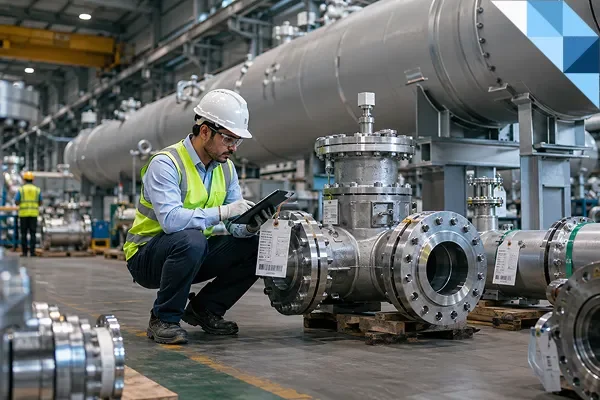

Vendor inspection becomes most valuable when the equipment is too critical to accept on paperwork alone.
A pressure vessel, valve or piping component may look complete at the supplier’s facility, but buyers still need evidence that materials, dimensions, testing, markings, documentation and open items match the purchase order and project requirements.
For critical industrial equipment, vendor inspection is not just a visit to the manufacturer. It is a structured verification process that helps buyers confirm whether the item is being manufactured, tested, documented and released according to the agreed requirements.
Vendor inspection for pressure vessels, valves and piping components should verify more than physical completion. It should confirm material traceability, dimensional conformity, inspection and test evidence, NCR status, preservation, marking and release readiness before the item is accepted or shipped.
Why Equipment-Specific Vendor Inspection Matters
Not all equipment carries the same inspection risk.
A pressure vessel, a control valve and a piping spool may all be part of the same project, but they do not require the same inspection focus. Pressure vessels depend heavily on material traceability, welding records, NDT, pressure testing and final dossier quality. Valves require attention to rating, material, marking, pressure tests, seat leakage and functional operation. Piping components require dimensional checks, heat number traceability, wall thickness, end preparation, marking and quantity verification.
This is why vendor inspection support should be planned by equipment type, not treated as a generic checklist.
For buyers and QA/QC teams, equipment-specific vendor inspection helps answer practical questions:
- Is the item built according to the purchase order and approved documents?
- Can the material be traced to certificates and markings?
- Were required inspections and tests completed?
- Are NDT and test reports consistent with the item being inspected?
- Are NCRs, repairs or deviations closed or formally accepted?
- Is the documentation package complete enough for release?
- Is the item ready for shipment without creating downstream risk?
This matters most when equipment is custom-made, safety-critical, pressure-retaining, project-specific or difficult to correct after shipment.
What Vendor Inspection Should Verify Across All Equipment Types
Although pressure vessels, valves and piping components have different inspection priorities, some checks apply across most industrial equipment orders.
A good vendor inspection should verify whether the equipment is physically acceptable, technically traceable and documentally ready for release.
Common checks include:
- Purchase order and specification compliance
- Approved drawing and revision status
- Material traceability
- Visual condition
- Dimensional conformity
- Nameplate, tag or marking accuracy
- Inspection and test records
- NDT records, where required
- Coating, painting or preservation condition
- Packing and shipment readiness
- NCR, concession or deviation status
- Final documentation package
- Release or hold status
These checks should not be performed mechanically. The inspector should understand what evidence matters for that specific equipment type.
For example, a missing pressure test record may be a major issue for a pressure vessel or valve. A heat number mismatch may be critical for piping components. An incorrect rating or nameplate may create acceptance problems for valves. An incomplete weld map may affect pressure vessel documentation.
Vendor inspection is useful because it brings these risks into view before shipment.
Pressure Vessel Vendor Inspection: Key Checks
Pressure vessels are among the most documentation-sensitive items in industrial procurement. Physical inspection matters, but the final acceptance decision often depends heavily on traceability, welding records, NDT, pressure testing and dossier completeness.
A pressure vessel vendor inspection should typically review:
- Approved drawings and latest revisions
- Material certificates for shells, heads, nozzles, flanges and pressure-retaining parts
- Heat number traceability
- Weld map and weld log
- WPS, PQR and welder qualification records
- NDT reports linked to weld numbers and acceptance criteria
- Dimensional inspection records
- Heat treatment records, where applicable
- Pressure test or hydrotest records
- Nameplate and marking
- Repair records and NCR status
- Final dossier or MDR package
For pressure vessels, the inspector should not only check whether documents exist. The records should match each other. The weld map should match NDT reports. Material certificates should match installed components. Pressure test records should identify the correct vessel and test conditions. NCRs and repairs should be closed or clearly dispositioned.
This is where pressure equipment documentation review becomes important. A pressure vessel may look complete in the workshop, but if the documentation package is incomplete or inconsistent, acceptance may still be weak.
NDT also needs careful review. The selected NDT method, extent and report should match the required inspection scope. For welded pressure parts, NDT method selection for pressure equipment inspection can affect whether the inspection evidence is suitable for acceptance.
The buyer’s question should be simple:
Does the pressure vessel file prove that the vessel was manufactured, inspected, tested and released against the required basis?
Valve Vendor Inspection: Key Checks
Valves can create serious project risk when the wrong rating, material, trim, test record or marking is accepted. A valve may be small compared with a vessel or package, but a nonconforming valve can affect pressure containment, isolation, leakage performance and installation readiness.
Vendor inspection for valves should usually verify:
- Valve type and service
- Size, pressure class or rating
- End connection type
- Body, bonnet and trim material
- Nameplate and permanent marking
- Casting or forging visual condition
- Dimensional checks
- Shell test records
- Seat leakage test records
- Functional operation
- Coating or painting condition
- Preservation of sealing surfaces and end connections
- Certificates and test reports
- Packing and tagging
The inspector should confirm that the valve matches the purchase order, datasheet, approved drawing and applicable specification. Marking should be checked carefully because it links the physical valve to its rating, material, size, direction, tag and traceability.
Testing is also central. Depending on the project requirement, valve inspection may include shell testing, seat leakage testing, backseat testing, functional checks or witnessing of specific test stages. The inspection record should make clear what was tested, under what requirement, and whether the result was accepted.
A common risk is accepting test reports without matching them to the exact valve or batch. Another is accepting valves with incomplete marking, damaged coating, poor preservation or unclear material traceability.
For buyers, valve vendor inspection is not only about whether the valve opens and closes. It is about whether the valve supplied is the valve ordered, tested and documented.
Piping Component Vendor Inspection: Key Checks
Piping components include pipes, fittings, flanges, elbows, tees, reducers, spools and related pressure-retaining items. These components may be purchased in large quantities, but that does not make inspection less important.
A small mismatch in material, schedule, rating, wall thickness or end preparation can create installation delays or compliance issues later.
Vendor inspection for piping components should typically verify:
- Material certificates
- Heat number traceability
- Size, schedule, rating or class
- Wall thickness and dimensions
- End preparation
- Flange facing and drilling
- Visual condition
- Marking and identification
- Quantity and packing list
- Coating, painting or preservation
- NDT records, where required
- Certificates and inspection reports
- Packing and protection for shipment
The inspector should check whether the physical marking matches the certificates and purchase requirements. This is especially important for mixed lots, similar-looking components, alloy materials, stainless steels or project-specific requirements.
Piping spools may require additional checks such as weld inspection, dimensional control, spool identification, NDT reports, coating records and packing condition.
For piping components, the risk is often not that a single item looks obviously wrong. The risk is that the wrong material, rating, schedule or documentation mismatch is discovered after the items arrive at site.
Vendor inspection helps catch these issues before shipment.
Documentation Review: Can the Buyer Trace What Was Inspected?
Vendor inspection is only useful if the inspection evidence can be traced to the correct equipment.
The documentation should allow the buyer to connect the physical item to the purchase order, drawing, material certificate, test report, NCR status and release decision. If that chain is broken, the inspection may still leave uncertainty.
Documentation review should check:
- Item, tag, serial or batch identification
- Drawing and revision consistency
- Material certificate traceability
- NDT report references, where applicable
- Pressure or functional test records
- Dimensional reports
- Coating or preservation records
- NCR, repair or concession status
- Final dossier or MDR status
- Inspection release note
This is where vendor inspection connects directly to the inspection release note. Before shipment, the release note should confirm whether inspection results are accepted, required documents are complete, NCRs are closed and release conditions are clear.
A documentation package does not need to be overcomplicated, but it must be reviewable. The buyer should be able to understand what was inspected, what was accepted, what remains open and whether shipment can proceed.
Inspection, Testing and Release: When Is the Item Ready for Shipment?
An item is not ready for shipment just because manufacturing is complete.
For critical industrial equipment, shipment should be based on a combination of physical condition, accepted inspection results, completed tests, closed NCRs, acceptable preservation and documentation readiness.
Before release, the buyer should verify:
- Inspection points have been completed
- Required tests have been performed and accepted
- NDT reports are available and traceable
- NCRs are closed or formally dispositioned
- Documentation package is complete enough for release
- Packing and preservation are acceptable
- Release conditions are clear
- Buyer or inspector approval is recorded
This is the point where vendor inspection and pre-shipment inspection often connect. Vendor inspection may cover manufacturing, testing and documentation throughout the order. Pre-shipment inspection acts as a final gate before dispatch.
In some cases, final random inspection may also be used to verify final condition, quantities, packing, marking and documentation readiness before shipment. But for critical equipment, final checks should be supported by earlier equipment-specific inspection evidence.
The release decision should not be based on schedule pressure alone. It should be based on accepted evidence.
Common Red Flags During Vendor Inspection
Vendor inspection often finds issues that are not obvious from procurement documents alone. Some are physical. Others are documentation-related. Both can affect acceptance.
Common red flags include:
- Material certificates do not match item markings
- Heat numbers are missing or unclear
- Drawing revisions are inconsistent
- Dimensions do not match approved drawings
- Wrong size, rating, class or schedule
- Nameplate data is incomplete or incorrect
- NDT reports are missing or not traceable
- Pressure test records are incomplete
- Seat leakage or functional test records are unclear
- NCRs remain open
- Repairs are not documented
- Coating or preservation is damaged
- Packing is not suitable for shipment
- Final documentation package is not ready
- Release status is unclear
These issues do not always mean the equipment must be rejected. But they should be clarified before shipment. Once the equipment leaves the supplier, resolving them may become more difficult, especially if site teams discover the problem during receiving, installation or commissioning.
The purpose of vendor inspection is to reduce that risk before it moves downstream.
Where NWE Supports Vendor Inspection for Critical Equipment
Vendor inspection for pressure vessels, valves and piping components requires technical understanding of the equipment, the purchase requirements and the evidence needed before release. It is not only a physical check at the supplier’s facility. It is a buyer protection activity.
NWE supports clients with vendor/source inspection, pressure equipment inspection, pre-shipment inspection, documentation review and release readiness checks for critical industrial equipment. As part of wider third-party inspection services, this support helps buyers verify material traceability, testing, NDT, marking, documentation, NCR closure and shipment readiness before equipment leaves the vendor.
For procurement teams, EPCs and asset owners, equipment-specific vendor inspection can reduce the risk of accepting incomplete, nonconforming or poorly documented equipment.
The goal is not to delay shipment. The goal is to make sure shipment is based on accepted evidence.
Frequently Asked Questions
What is checked during vendor inspection for pressure vessels?
Vendor inspection for pressure vessels usually checks material traceability, welding records, NDT reports, dimensional inspection, heat treatment records where applicable, pressure test records, nameplate, NCRs, repair records and final dossier status.
What is checked during valve vendor inspection?
Valve vendor inspection typically checks valve type, size, rating, body and trim material, marking, dimensions, shell test records, seat leakage test records, functional operation, coating, preservation and certificates.
What is checked for piping components at the vendor?
Piping component inspection usually checks material certificates, heat numbers, dimensions, schedule or rating, wall thickness, visual condition, marking, coating or preservation, quantities, packing and documentation.
Is vendor inspection the same as pre-shipment inspection?
No. Vendor inspection can cover manufacturing, testing, documentation and release points at the supplier. Pre-shipment inspection is usually the final check before dispatch.
Why is equipment-specific vendor inspection important?
Equipment-specific vendor inspection is important because pressure vessels, valves and piping components have different risks, test requirements, documentation needs and acceptance criteria. A generic inspection may miss issues that are critical for a specific equipment type.