
How NWE verified welding quality, documentation integrity, and PED compliance before a procedure moved into future fabrication use.
Project Snapshot
| Industry | Industrial Manufacturing |
| Asset / Scope | MAG Welding Procedure Qualification |
| Service | Independent Welding Inspection |
| Standards | PED 2014/68/EU · ISO 15614-1 · ISO/IEC 17020 Type A |
| Location | Confidential European Manufacturing Facility |
| Status | Successfully Completed with Zero Non-Conformities |
The Challenge: Qualification Is Not Just a Weld Test
Before a welding procedure can be trusted in production, the weld itself is only one part of the evidence.
For manufacturers working under the Pressure Equipment Directive, qualification must demonstrate that the process is repeatable, traceable, and controlled from preparation to final acceptance. Welding parameters, material certificates, consumables, shielding gas, equipment calibration, inspection records, and test documentation must all support the same technical conclusion: the procedure is suitable for future fabrication.
The client required independent verification of a MAG welding procedure for structural steel applications. The challenge was not simply to confirm that one weld looked acceptable. It was to verify that the entire qualification process could stand up to technical, regulatory, and audit scrutiny.
This type of work sits at the core of NWE’s Welding Inspection capability, where inspection value depends on controlling the full evidence chain, not only reviewing the final result.
NWE’s Approach: Verifying the Full Qualification Chain
NWE acted as an independent ISO/IEC 17020 Type A inspection body, witnessing and verifying the qualification process under controlled workshop conditions.
The first step was to confirm that the qualification basis was technically complete. Preliminary Welding Procedure Specifications, parent material certificates, consumable batch information, shielding gas documentation, equipment calibration records, and supporting quality documents were reviewed before and during the qualification activity.
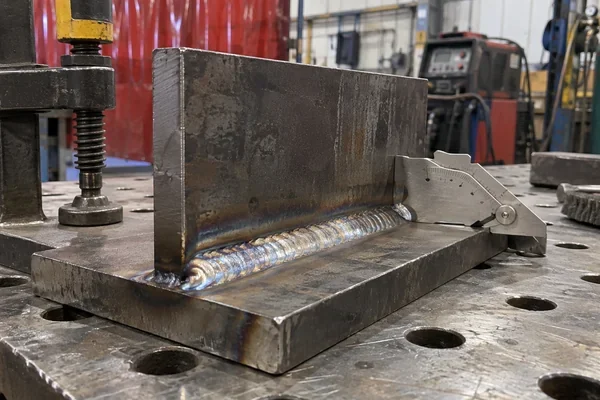
The welding process was then witnessed to confirm that essential variables remained controlled. Welding parameters, equipment suitability, material traceability, and consumable selection were checked against the qualification requirements. The completed weld was visually inspected and dimensionally verified, with achieved weld geometry confirming the specified profile.
This approach reflects the same principle used across NWE’s wider Inspection Services: inspection is strongest when technical execution and documentation integrity are verified together.
Results & Value Delivered
The welding procedure qualification was successfully completed, accepted, and documented with zero non-conformities. No punch list items, rejectable defects, or reportable deficiencies were identified during the qualification process.
Key Outcomes
- MAG welding procedure successfully qualified.
- Independent witnessing completed under controlled workshop conditions.
- Welding parameters, calibration status, and equipment suitability verified.
- Material, consumable, and shielding gas traceability confirmed.
- Visual and dimensional inspection completed with acceptable weld profile.
- Supporting NDT and mechanical testing documentation reviewed.
- Fully documented qualification package prepared for future production use.
The value delivered was confidence before production. By independently verifying both the weld and the supporting records, NWE helped reduce compliance risk, strengthen audit readiness, and provide a traceable basis for using the qualified procedure in future pressure equipment or structural fabrication activities.
For organisations preparing regulated fabrication work, this also connects directly to Pressurized Equipment Inspection, where production readiness depends on verified procedures, controlled welding variables, and complete technical documentation.
Why This Project Matters
A welding procedure qualification is not just a formality. It is a control point before production risk becomes embedded into manufactured components.
When qualification records are incomplete, future fabrication can face approval delays, non-conformities, or uncertainty during client and regulatory review. Independent verification gives manufacturers objective evidence that the procedure was qualified correctly, documented properly, and is ready to support compliant production.
For NWE, the important engineering question was simple: can this procedure be trusted beyond the test coupon? The verified result gave the client a clear answer.
Qualification & Compliance Basis
This welding procedure qualification was verified using recognised welding, pressure equipment, and independent inspection requirements:
| Basis | Role in This Project |
| PED 2014/68/EU | Pressure equipment compliance and regulatory framework |
| ISO 15614-1 | Welding procedure qualification requirements |
| ISO/IEC 17020 Type A | Independent third-party inspection framework |
Need Independent Welding Qualification Support?
NWE supports manufacturers with independent welding inspection, qualification witnessing, and pressure equipment compliance verification before production release.
Contact NWE to discuss your qualification or inspection requirements.