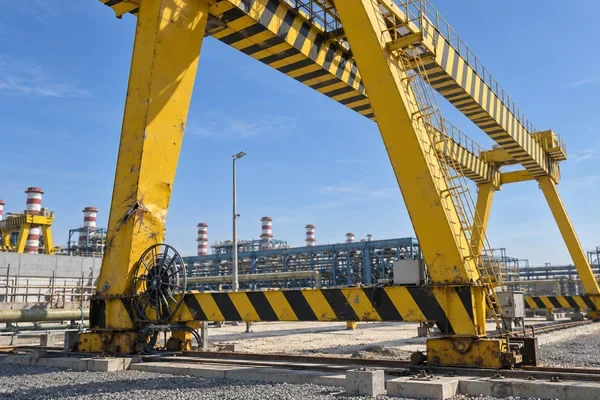

How NWE controlled engineering uncertainty before dismantling a damaged 81.5-tonne gantry crane.
Project Snapshot
| Industry | Heavy Industrial Infrastructure |
| Asset / Scope | Accident-Damaged Gantry Crane |
| Service | Structural Engineering & Dismantling Engineering |
| Scope | 3D Model Verification · Weight & CoG Reconciliation · Lifting Design · Nonlinear FEM |
| Standards / Basis | NORSOK R-002 · FEM 1.001 · 2nd-Order Nonlinear Analysis |
| Status | Successfully Delivered |
The Challenge: Engineering After Failure
After a severe industrial accident, the client needed to dismantle a large-capacity gantry crane without creating a second structural failure.
The critical issue was not simply how to lift the crane. The existing engineering model could no longer be accepted without verification. The damaged structure had to be checked against original OEM drawings, the true self-weight and centre of gravity had to be reconciled, and every lifting and storage condition had to be proven before execution.
In this context, assumptions were a risk. A wrong centre of gravity, an inaccurate model, or an under-designed lifting attachment could compromise the dismantling sequence. The client required a complete engineering package that could turn uncertainty into a controlled, traceable, execution-ready plan.
NWE’s Engineering Approach: Rebuilding Confidence Before the First Lift
Before lifting design could begin, the engineering basis had to be rebuilt.
NWE first validated the client-supplied 3D model against the original OEM documentation. Several discrepancies were identified and corrected, including connection geometry, span differences, and missing structural elements such as stiffeners and connection plates. This step was essential because every calculation that followed depended on the reliability of the model.
Once the geometry was corrected, the crane weight and centre of gravity were recalculated using verified material properties and plate thicknesses. The structural self-weight was then reconciled against the OEM total weight of 81.5 tonnes, creating a conservative engineering basis for lifting and support design.
From that verified baseline, NWE engineered twelve lifting padeyes: four main lifting eyes rated at 35 tonnes WLL and eight secondary lifting eyes rated at 12 tonnes WLL, designed in accordance with NORSOK R-002. Temporary ground support structures were also developed to store the main girders safely after lowering.
The project was closely aligned with NWE’s Structure Stress Analysis and Structural Integrity Assessment capabilities, where engineering decisions must be supported by verified data, not visual judgement alone.
Results & Value Delivered
The final deliverable was not a single calculation package. It was a complete dismantling engineering system.
NWE delivered a corrected 3D model, verified weight and centre of gravity data, shop-ready AutoCAD drawings for all lifting eyes, temporary support frame drawings, FEM analysis reports, cable verification, and a full dismantling sequence prepared for execution.
Key Outcomes
- Corrected 3D model verified against OEM drawings.
- Crane weight and centre of gravity independently reconciled.
- Twelve lifting padeyes engineered to NORSOK R-002.
- Temporary supports verified for ground storage conditions.
- 2nd-order nonlinear P-Delta FEM analysis completed.
- Wind load assessment performed for 28 m/s design wind speed.
- Shop-ready engineering package delivered for safe dismantling.
The structural analysis confirmed controlled stress and deflection behaviour across the critical lifting and support scenarios. Temporary supports showed maximum deflection below L/1000, and stress utilisation remained within acceptable limits, giving the client a verified basis for execution.
The value of the project was not only in designing lifting attachments. It was in removing avoidable uncertainty from a high-risk dismantling operation before field execution began.
Why This Project Matters
After structural failure, dismantling is no longer a routine lifting activity. It becomes an engineering decision process.
The damaged structure must be understood before it can be moved. Load paths change. Support conditions change. Original assumptions may no longer apply. That is why independent engineering verification is critical before any major lifting or decommissioning operation involving damaged assets.
For owners, contractors, and project teams, this type of work supports safer execution, clearer responsibility, and stronger control over risk before field operations begin. It is also directly connected to NWE’s broader Asset Integrity Management approach: decisions should be made from evidence, not uncertainty.
Need Engineering Confidence Before Critical Lifting or Dismantling?
NWE supports complex lifting, structural verification, and dismantling projects with independent engineering analysis, verified models, and execution-ready documentation.
Contact NWE to discuss your critical engineering requirements.