
Many welding problems are discovered after welding, but they often begin before the arc is struck.
A missing qualification record, poor fit-up, wrong consumable, uncontrolled preheat, poor cleaning between passes or undocumented repair can create quality problems that final inspection only finds too late. By that point, the issue may already have become rework, an NCR, a delivery delay or a documentation gap.
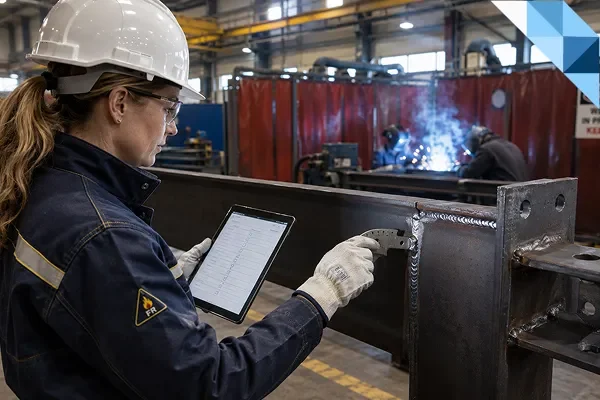
That is why an effective welding inspection checklist should not focus only on final visual acceptance. Welding inspection is a staged QA/QC process that starts before welding begins, continues during welding and ends with visual inspection, NDT, repair control, documentation review and final acceptance evidence.
A welding inspection checklist should cover pre-welding document and fit-up checks, during-welding process control, and post-weld visual, NDT, repair and documentation review. For QA/QC teams, welding coordinators, vendor inspectors and project teams, the purpose is simple: control the welding process early enough to prevent avoidable defects, rework and acceptance problems.
Why Welding Inspection Should Start Before Welding Begins
Welding inspection is not only about finding defects after fabrication is complete. In industrial projects, the real value of inspection is often in identifying risks before they become rejectable findings.
Poor joint preparation, incorrect consumables, incomplete traceability or missing welder qualifications may not be obvious in final inspection until significant welding work has already been completed. At that stage, correcting the issue may require repair welding, additional NDT, NCR close-out, schedule recovery and additional documentation review.
A staged inspection approach helps QA/QC teams verify that welding activities remain aligned with approved procedures, project specifications and acceptance requirements throughout fabrication.
This is also why professional welding inspection services typically include document review, fit-up verification, process monitoring, visual inspection, NDT coordination and final reporting — not only end-of-job checks.
A welding inspection checklist is most useful when it follows the actual welding sequence: before welding, during welding and after welding.
Before Welding: Documents, Materials and Joint Preparation
The pre-welding stage is where many quality problems can be prevented. Documentation gaps, incorrect materials or poor fit-up conditions can create issues that become much harder to correct once welding has started.
Typical pre-welding inspection checks include:
- Approved drawings and specifications
- Availability of approved WPS documents
- Supporting PQR documentation
- Welder qualification records
- Material identification and traceability
- Consumable type, storage and condition
- Joint preparation and bevel geometry
- Fit-up, root gap and alignment
- Tack weld quality
- Preheat requirements
- Environmental conditions
- Inspection hold or witness points
The inspector should confirm that the correct WPS is available at the work location and that it is applicable to the actual job. The WPS should match the welding process, material, thickness range, joint type, position, filler metal, preheat requirement and other essential variables.
Welder qualification is equally important. Welders should be qualified for the process, position, material group and thickness range they are assigned to weld. A missing or expired qualification record can create acceptance problems even if the weld appears visually acceptable.
Material traceability is also critical for pressure equipment and fabricated components. Heat numbers, material certificates and weld mapping should remain consistent with fabrication records throughout production. In projects involving regulated equipment or manufacturing dossiers, a structured pressure equipment documentation review can help verify that traceability and supporting records are complete before acceptance.
Joint preparation and fit-up should be checked carefully before welding begins. Incorrect bevel angles, excessive hi-lo, poor alignment, contaminated surfaces or poor tack welds can contribute to weld quality problems later in the process.
For fabricated equipment supplied by third parties, many project teams also rely on vendor inspection support to verify welding readiness before production welding starts.
During Welding: Process Control and WPS Compliance
During welding, inspection becomes more focused on process control and compliance with approved welding requirements.
Even when documents and fit-up are acceptable at the start, welding variables can drift during production if they are not monitored consistently. This is where in-process inspection helps maintain stability before defects become visible in final inspection.
Typical during-welding inspection checks include:
- Welding process matches the approved WPS
- Correct consumables are in use
- Preheat is maintained during welding
- Interpass temperature is controlled
- Cleaning between passes is performed
- Root pass condition is checked
- Weld sequence is followed
- Distortion control measures are applied
- Protection against weather or contamination is maintained
- Stop and restart areas are controlled
- Inspector observations and process records are documented
This stage is important because many welding problems develop progressively during fabrication rather than appearing suddenly at final inspection.
For example, poor cleaning between passes, incorrect heat control or unsuitable consumables may increase the risk of lack of fusion, porosity or cracking. Uncontrolled distortion or improper weld sequencing may affect dimensional tolerances and assembly quality. Poor root pass control may create defects that are difficult to correct later without repair.
During-welding inspection should not be seen as unnecessary interruption. It is a way to confirm that the actual production conditions still match the approved welding basis.
The objective is not only to detect problems. It is to maintain process control before defects become rejectable findings.
After Welding: Visual Inspection, NDT and Acceptance Evidence
Post-weld inspection verifies weld quality, confirms acceptance criteria and ensures that supporting evidence is complete.
This stage should not be treated as a quick final look. It is the point where the physical weld, NDT requirements, repair status and documentation record come together.
Typical after-welding inspection checks include:
- Weld profile and reinforcement
- Undercut, overlap and surface cracks
- Arc strikes, craters and spatter
- Surface condition and cleanliness
- Dimensional verification
- NDT requirements
- Repair area identification
- Acceptance criteria compliance
- Final inspection traceability
Visual inspection is usually the first stage of post-weld acceptance. Inspectors may evaluate weld appearance, profile consistency, surface condition and dimensional compliance before NDT activities begin.
Where required, additional non-destructive testing methods such as UT, RT, MT or PT may be used to verify weld integrity beyond surface-level examination. The method and extent should match the ITP, project specification, code requirement or client acceptance basis.
NDT findings should be reviewed together with weld identification, acceptance criteria and repair history. Understanding acceptance statements, indications and reporting terminology is also important when evaluating inspection outcomes. This is one reason many QA/QC teams need to understand how to read an NDT report before accepting it into the final dossier.
For buyers and project teams, the final question is not only whether the weld looks acceptable. The more important question is whether the inspection evidence is strong enough to support acceptance, release or handover.
Common Welding Issues the Checklist Helps Catch Early
A structured welding inspection checklist helps identify process and quality risks before they become major fabrication problems.
Many common welding defects are linked to issues that can be controlled before or during welding. The purpose of this article is not to repeat a full welding defects guide, but it is useful to understand how staged inspection helps reduce common failure points.
Typical issues that a checklist may help catch earlier include:
- Porosity
- Lack of fusion
- Cracking
- Undercut
- Incomplete penetration
- Misalignment
- Poor surface finish
- Documentation gaps
- Traceability problems
- Incorrect consumable use
Porosity may be linked to contamination, poor shielding, moisture or consumable condition. Lack of fusion may be linked to poor technique, incorrect parameters, poor joint preparation or insufficient heat input. Cracking may be influenced by material condition, restraint, hydrogen control, preheat or cooling rate.
The checklist helps inspectors move upstream. Instead of only identifying a defect after welding, it helps verify whether the conditions that lead to defects are being controlled.
Repair, Re-Inspection and Documentation Control
Not every weld is accepted the first time. When rejectable findings occur, repair activities should be controlled and properly documented.
Repair is not only a physical correction. It is also an inspection and documentation process.
The inspection process should verify:
- Repair area identification
- Approved repair method
- Repair WPS requirements
- Defect removal before repair
- Inspection of excavation, where applicable
- Re-inspection activities
- Additional NDT, if required
- Repair traceability
- Final acceptance status
- NCR closure
In some cases, projects may require a dedicated repair welding procedure depending on material type, service conditions, code requirements or the criticality of the component.
After repair welding is completed, re-inspection and any required repeat NDT should confirm that the repaired area now meets acceptance criteria.
Repair documentation should remain linked to weld maps, inspection reports and NCR records to maintain full traceability. A common mistake is to document the original rejected indication but not clearly document the repair and re-test. In that case, the final status of the weld may remain unclear even if the physical repair was completed.
What Should Be Included in a Welding Inspection Record?
Inspection records provide evidence that welding activities were performed and verified according to project requirements.
A welding inspection checklist is only useful if the results are documented clearly. The record should allow someone else to understand what was checked, when it was checked, what was found and whether the weld was accepted.
Typical welding inspection records may include:
- Project, equipment or weld identification
- Drawing or weld map reference
- WPS reference
- Welder identification
- Material or heat number reference, where relevant
- Inspection stage
- Fit-up observations
- Preheat or interpass records
- Visual inspection findings
- NDT references
- Repair and retest information
- Acceptance criteria
- Acceptance status
- Inspector signature and date
- NCR references
Well-structured inspection records help support final acceptance, audit readiness and long-term traceability.
In welded equipment, inspection evidence is not only for the inspector. It may be reviewed later by QA/QC teams, buyers, project managers, site teams, documentation reviewers and asset owners.
Where NWE Supports Welding Inspection and QA/QC Control
Welding inspection works best when it is planned across the full welding process: before welding, during welding and after welding. If inspection starts only at the end, defects and documentation gaps may already have become rework, NCRs or delivery risks.
NWE supports industrial projects with third-party welding inspection, vendor inspection, NDT coordination and QA/QC documentation review across the full welding cycle — from document and fit-up checks before welding to process control during welding and final acceptance evidence after welding.
The focus is not only on identifying defects after welding, but on improving inspection control throughout fabrication. This includes support related to procedure compliance, traceability, visual inspection findings, NDT coordination, repair control and acceptance documentation.
For manufacturers, buyers, EPC teams and asset owners, a structured welding inspection approach helps make weld quality more controllable and acceptance decisions easier to defend.
Frequently Asked Questions
What should be included in a welding inspection checklist?
A welding inspection checklist should include pre-welding document and fit-up checks, during-welding process control, post-weld visual inspection, NDT requirements, repair status and final acceptance documentation.
What should be checked before welding?
Before welding, inspectors should verify WPS availability, PQR support, welder qualification, material traceability, consumables, joint preparation, fit-up, preheat requirements and inspection hold points.
What should be checked during welding?
During welding, inspectors typically verify WPS compliance, consumable use, preheat and interpass temperature, cleaning between passes, root pass condition, welding sequence and process control variables.
What should be checked after welding?
Post-weld inspection usually includes visual condition, weld profile, surface defects, dimensions, NDT requirements, repair status, acceptance criteria and final inspection documentation.
Why is welding inspection needed before final inspection?
Many weld quality problems begin before or during welding. Early inspection helps reduce rework, NCRs, repair activities and project delays instead of only discovering problems after the weld is complete.