
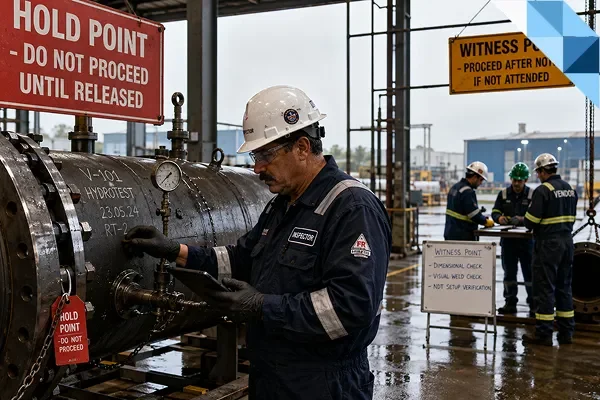

Hold Point vs Witness Point in an ITP
Coverage Rules Procurement and QA Teams Use to Prevent Rework
If your ITP is meant to protect acceptance and release decisions, the hold and witness logic must be explicit. Otherwise, you end up with the two most expensive outcomes at vendors:
work proceeds past a critical stage without verification, or attendance is requested too late and becomes a scheduled fight.
This guide explains what hold points and witness points actually mean in manufacturing, how to assign them, and how to set notification windows that work in real life.
Quick answer: hold point vs witness point
A hold point is a mandatory stop. The vendor cannot proceed until the required inspection activity is performed and released.
A witness point is a scheduled observation opportunity. The vendor may proceed if the inspector does not attend, provided notification was given and evidence requirements are met.
The practical difference is not the words. It is the risk you accept if the step proceeds without your presence.
Why coverage rules matter for release decisions
Most disputes are not about whether someone “looked at it.” They are about whether the evidence is defensible when someone asks:
- Was the correct revision used at the time of inspection
- Was the critical step verified before it became irreversible
- Can the release decision be justified using objective evidence tied to requirements
Coverage rules are how you protect acceptance when time pressure at the vendor is high.
What to classify as a hold point
Use a hold point when skipping attendance creates irreversible acceptance risk. Typical triggers:
- The activity will be hidden later and cannot be verified without destructive work
- Rework is expensive or schedule critical if an issue is found late
- The step is a compliance gate with strict acceptance criteria
- The step is a known repeat NCR driver for that supplier category
Examples that are frequently treated as hold points:
- material identification and traceability verification before fabrication starts
- weld fit-up or welding parameters for critical joints
- critical dimensional stage before enclosure, coating, or assembly closure
- Hydrostatic test , or any pressure tightness tests
- FAT steps where pass or fail drives shipment release readiness
What to classify as a witness point
Use a witness point when verification is still valuable, but the step is recoverable or can be proven by evidence if attendance is missed. Typical triggers:
- the activity can be repeated or rechecked without major rework
- the acceptance criteria can be demonstrated by records, calibrated measurements, and traceable photos
- you need visibility for confidence, not a hard release gate
Witness points work best when evidence requirements are written clearly in the ITP, not assumed.
Hold and witness coverage table you can use in an ITP
| Decision question | If yes | Coverage type |
| If we miss this step, can we still verify acceptance later without rework | No | Hold point |
| Will this step be hidden or inaccessible after the next operation | Yes | Hold point |
| Does this step control a known failure mode or frequent NCR driver | Yes | Hold point or hold with conditional release |
| Can acceptance be proven by objective records and traceable evidence even if we do not attend | Yes | Witness point |
| Is this mainly schedule visibility or confidence monitoring | Yes | Witness point or surveillance point |
If you want the ITP to map cleanly to execution and evidence collection, the next step is defining scope and visit planning. See how to build that: vendor inspection scope and visit plan.
Notification windows for witness points that actually work
A witness point is only meaningful if the vendor must notify you early enough to attend. A practical rule set:
- define notification lead time for each witness point based on vendor operations
- define a confirmation requirement for attendance when the point is time-critical
- define what happens if notification is late or missed
Typical patterns that reduce conflict:
- 48 hours notice for planned tests and FAT steps
- 24 hours notice for routine shop floor checkpoints
- same-day notice only for low-consequence observation items, and only if evidence rules are strong
Put the notification rule inside the ITP so it is not negotiated during the visit.
Common hold and witness mistakes that cause rework
Calling everything a hold point
You create artificial schedule stops, vendor pushback, and rushed attendance. Coverage becomes impossible and the system collapses.
Using witness points with no evidence requirements
Then a missed witness becomes a missed verification. You lose defensibility at the release stage.
Leaving hold and witness logic vague
Terms like “as required” or “as applicable” invite disputes. Coverage must be binary enough to execute.
Treating hold and witness as the only options
Many ITPs benefit from a third layer: surveillance checkpoints. These are not formal stops but still require evidence and reporting discipline.
Minimum attendance plan for procurement and QA
If you need a starting point that is defensible, use this hierarchy:
- assign hold points to irreversible, hidden, or compliance-critical activities
- assign witness points to high-value checkpoints where evidence can still prove acceptance
- define a small set of surveillance checkpoints to confirm day-to-day control
- tie every checkpoint to evidence outputs and release logic
When repeat NCRs are the problem, coverage rules should target the drivers, not generic checkpoints. Use this guide to identify what typically repeats and how to stop it: common vendor NCR drivers and prevention actions.
Evidence rules that make witness points defensible
If a witness point can proceed without attendance, your ITP should require objective evidence. Practical requirements include:
- requirement reference for each checkpoint
- calibrated measurement records where applicable
- traceable photos showing markings, settings, and results
- time and date traceability in the report package
- identification of who performed and who verified
This is the difference between a witness point that protects release and one that only creates noise.
Hold point vs witness point in an ITP FAQ
What is a hold point in an ITP
A hold point in an ITP is a mandatory stop where the vendor cannot proceed until the defined inspection activity is completed and released by the required party.
What is a witness point in an ITP
A witness point in an ITP is a planned checkpoint where the vendor must notify the inspector for attendance, but the vendor may proceed if the inspector does not attend, provided notification and evidence rules are met.
Hold point vs witness point: which one prevents rework
Hold points prevent rework when the activity is irreversible, hidden later, or a known defect driver. Witness points prevent rework only when evidence requirements are strong enough to prove acceptance even if attendance is missed.
What is the best notification window for witness points
A practical witness point notification window is 24 to 48 hours depending on the activity and scheduling constraints, with explicit rules for late notification and missed attendance.
Can a witness point support shipment release decisions
A witness point can support release decisions only if the ITP requires objective evidence tied to acceptance criteria and the evidence package is traceable and complete.