

When a vessel reaches a docking decision window, the question is not simply “Can we inspect underwater?” The real question is whether an Underwater Inspection In Lieu of Drydocking (UWILD) can produce an evidence package that Class Society and Flag will accept as equivalent—without increasing technical risk or deferring critical findings.
UWILD is not a shortcut. Done correctly, it is a controlled integrity decision supported by clear eligibility criteria, a tight method statement, evidence discipline, and defensible acceptance logic. Done poorly, it becomes a deferral mechanism that increases uncertainty, cost, and exposure.
This article explains UWILD versus drydocking from an engineering and compliance perspective: what drives approval, what must be covered, what commonly causes rejection, and how to deliver review-ready outputs—especially when using ROV-based inspection.
UWILD vs Drydocking: What Changes in Access and Confidence
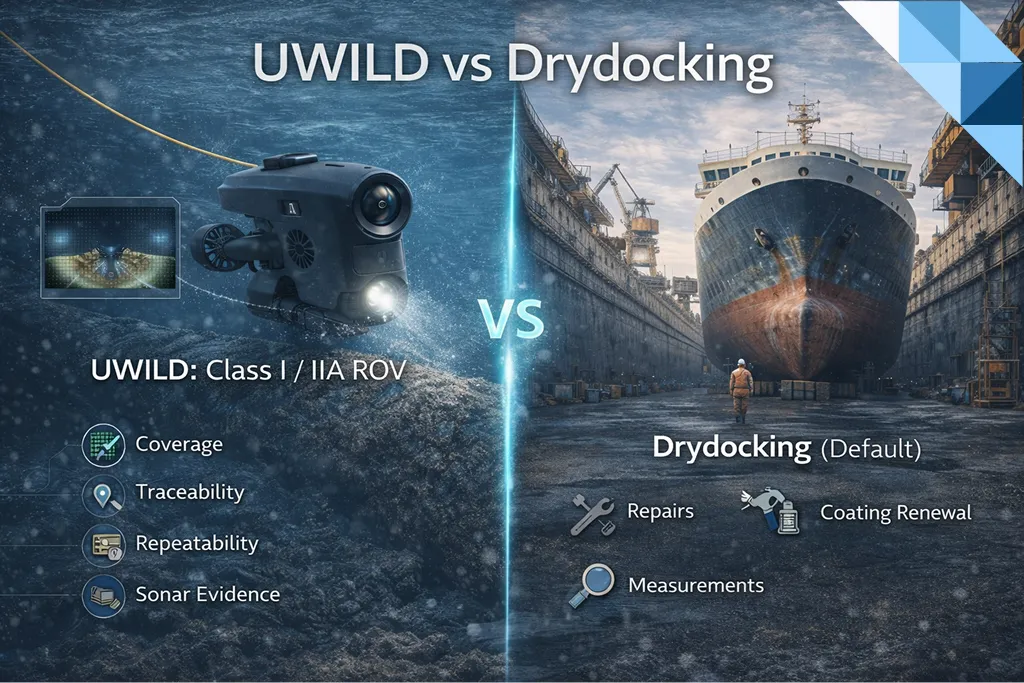
Drydocking (Default)
Drydocking provides direct access to hull and appendages with high confidence for:
- close visual examination and measurements,
- repairs and replacements,
- coating renewal,
- class-required examinations that need out-of-water access.
UWILD (Approved Alternative)
UWILD is an underwater inspection carried out in lieu of drydocking scope, subject to Class/Flag acceptance. It can be effective when:
- the vessel is eligible,
- the scope aligns with class rules,
- evidence quality is high,
- limitations and uncertainty are explicitly managed.
When UWILD Is Typically Allowed: Eligibility Drivers
UWILD approval is ultimately a Class/Flag decision, but outcomes are strongly influenced by these factors:
1) Vessel history and condition stability
- stable inspection history with no unresolved critical findings,
- acceptable prior docking/UWILD outcomes,
- no recent damage history (collision/grounding) unless specifically evaluated and scoped.
2) Site conditions and constraints
- visibility/turbidity profile (impact on defect detectability),
- currents/tides and station-keeping feasibility,
- marine growth level (masking risk).
3) Critical systems and scope type
UWILD is most defensible when the scope is explicit, including (as applicable):
- hull external condition,
- appendages (rudder, propeller, thrusters),
- sea chests/gratings,
- anodes and CP status,
- sea connections and overboard areas,
- class-noted areas of concern.
4) Evidence capability
Reviewers need to confirm:
- coverage and proximity (GVI/CVI where required),
- location traceability,
- repeatable media and documentation quality.
In low visibility, sonar-based coverage evidence can be decisive for defending the coverage statement:
Low-Visibility Playbook: Multibeam & Imaging Sonar as Coverage Evidence
https://nwegroup.no/low-visibility-sonar-coverage-proof/
Class/Flag Approval Workflow: How UWILD Gets Accepted
Step 1 — Pre-approval submission
A typical UWILD submission includes:
- vessel particulars and class status,
- proposed inspection location and expected conditions,
- method statement and defined scope,
- diver/ROV plan (or hybrid),
- deliverables and evidence plan,
- limitations and risk controls.
Step 2 — Scope alignment and acceptance expectations
Class/Flag typically clarifies:
- minimum coverage requirements,
- required close inspection areas,
- measurement requirements (if any),
- reporting format and evidence expectations,
- escalation rules (what triggers drydock recommendation).
Step 3 — Execution with reviewer-friendly evidence discipline
Execution must allow a third party to verify:
- what was inspected,
- where it was inspected,
- how it was inspected,
- what was found,
- and what is recommended.
Step 4 — Review, disposition, and closure
Outcomes typically fall into:
- UWILD accepted in lieu of drydock,
- conditional acceptance (mitigation required),
- drydock required due to findings or insufficient evidence.
UWILD Execution: Diver vs ROV (Engineering Selection)
Platform selection should follow:
- safety profile,
- evidence needs,
- accessibility and station-keeping,
- expected conditions (visibility/current),
- tooling/measurement requirements.
ROV capability and scope realism
For ROV-based UWILD, scope must match the platform’s capabilities. NWE’s underwater capability is based on ROV Class I and Class IIA systems (not work-class). This is typically strong for:
- GVI/CVI evidence collection,
- coverage proof and condition screening,
- selected measurement tasks within tooling limits.
Tasks requiring heavy intervention tooling should be planned via alternative methods or supported operations.
What UWILD Must Cover: Typical Engineering Scope
1) Hull external condition (general + close)
- broad route-based coverage (GVI),
- close inspection (CVI) at:
- weld seams and known stress concentration areas,
- bilge radius and transition zones,
- previously repaired or historically problematic locations,
- areas requested by Class/Flag.
2) Appendages and propulsion-related items
- rudder, propeller/CPP hub (as applicable), thrusters,
- stern gear visible interfaces,
- nozzles, stabilizers (if fitted).
3) Sea chests / gratings / inlets (as applicable)
- grating condition and fouling,
- visible integrity and blockage risk.
4) CP and anodes
- anode condition and attachment,
- CP evidence where required or where anomalies are suspected.
5) Event-driven checks (when triggered)
If impact/grounding is suspected, UWILD scope must be tightened to the event footprint with evidence adequate for engineering disposition.
Underwater Measurements: When They’re Required and How to Make Them Defensible
UWILD is often visual-dominant, but measurements may be required when:
- corrosion risk is credible,
- acceptance needs quantified wall thickness,
- condition trending is necessary for disposition.
Measurement discipline and repeatability are critical. For practical controls that keep UT/CP outputs repeatable and reviewer-friendly:
ROV-Deployed NDT in Practice: UT & CP That Deliver Repeatable, Class-Ready Results
https://nwegroup.no/rov-ndt-ut-cp-best-practice/
Why UWILD Gets Rejected: Common Failure Modes
1) Weak coverage proof
- no route/grid logic,
- poor mapping to hull zones,
- incomplete time-coded evidence.
2) Poor visibility without compensating evidence
- defect detectability reduced,
- coverage claims not defensible without sonar support.
Recommended reading for coverage proof in turbidity:
https://nwegroup.no/low-visibility-sonar-coverage-proof/
3) Marine growth masking
- coating breakdown and cracking can be concealed,
- confidence drops unless cleaning policy and limitations are explicit.
4) Station-keeping and access constraints
- unstable close inspection,
- geometry prevents required proximity.
5) Over-claiming conclusions
Reviewers accept limitations; they reject uncertainty presented as certainty.
Deliverables UWILD Reviewers Typically Expect
A reviewer-friendly UWILD package includes:
1) Method statement summary
- platform (diver/ROV/hybrid),
- operating constraints,
- cleaning policy,
- measurement approach (if any).
2) Coverage evidence
- zone plan and route map,
- time-coded video index tied to zones.
3) Findings register
- unique IDs,
- zone/location,
- severity,
- evidence references (timecode/media),
- disposition recommendation.
4) Measurement pack (when applicable)
- UT/CP tables tied to location IDs,
- verification/calibration records retained with the dataset.
5) Technical conclusion
- accepted / conditional / drydock required,
- basis and limitations,
- escalation recommendations where relevant.
UWILD Decision Logic: When It’s a Good Alternative (and When It Isn’t)
UWILD is typically appropriate when:
- history supports stability,
- evidence quality can be controlled,
- site conditions support close inspection,
- scope requirements are compatible with underwater execution.
UWILD is typically not appropriate when:
- known damage exists without a narrow, high-confidence plan,
- visibility/access makes close inspection unreliable,
- marine growth prevents defensible conclusions,
- repairs are anticipated.
FAQs
Is UWILD equivalent to drydocking?
UWILD can be accepted in lieu of drydocking for defined scopes when eligibility criteria and evidence quality requirements are met. It is not a blanket replacement.
What usually makes UWILD faster to approve?
A clear scope, strong coverage proof, and deliverables structured for third-party review (traceable zones, time-coded evidence, and a clean findings register).
How do you defend UWILD in poor visibility?
Plan for turbidity and include sonar-based coverage evidence so coverage claims remain defensible:
https://nwegroup.no/low-visibility-sonar-coverage-proof/
Does UWILD reduce cost?
It can reduce downtime and docking logistics when eligible and well executed. Poor evidence quality often creates rework and may still force drydock—eliminating savings.
