
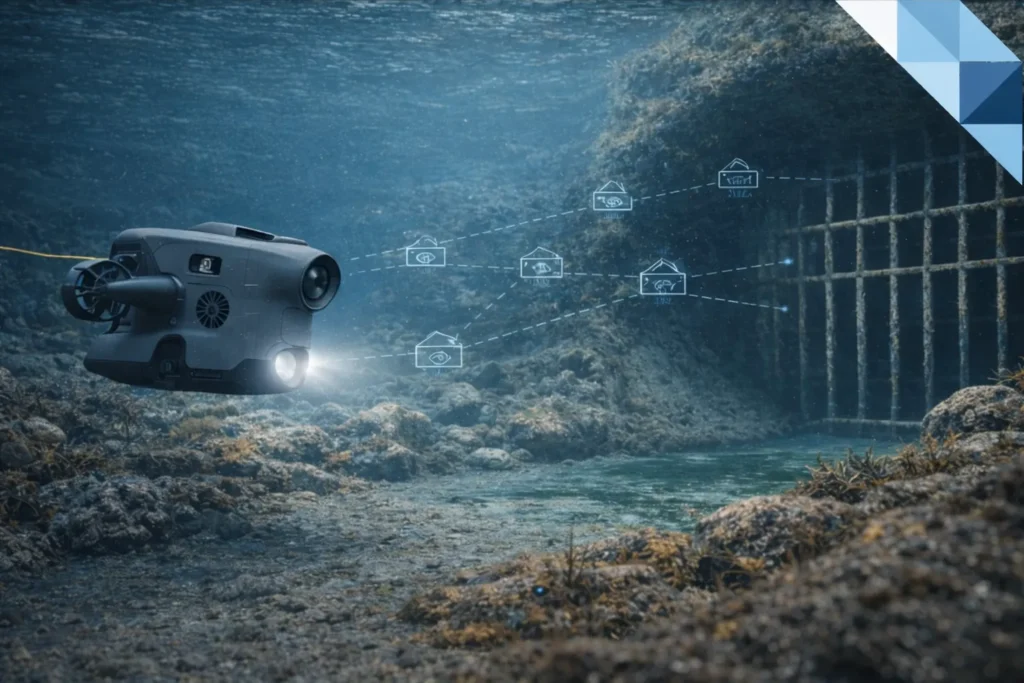

For utilities, dams, and water intakes, ROV-based in-water inspections make it possible to inspect critical assets without draining reservoirs or shutting down intake systems. A well-designed no-drain inspection program focuses on coverage certainty, hygiene control, and actionable reporting—not just collecting video.
When the goal is “operate through inspection” without compromising acceptance, the scope and deliverables must be defined up front. This is exactly what NWE builds into Underwater Inspection (ROV) under Inspection Services so utilities can keep production online while still producing evidence that stands up to QA and regulators.
Inspection findings can then feed directly into a governance cadence such as Risk-Based Inspection (RBI) to minimize outages while maintaining integrity and compliance.
Why No-Drain ROV Inspections Matter for Utilities & Asset Owners
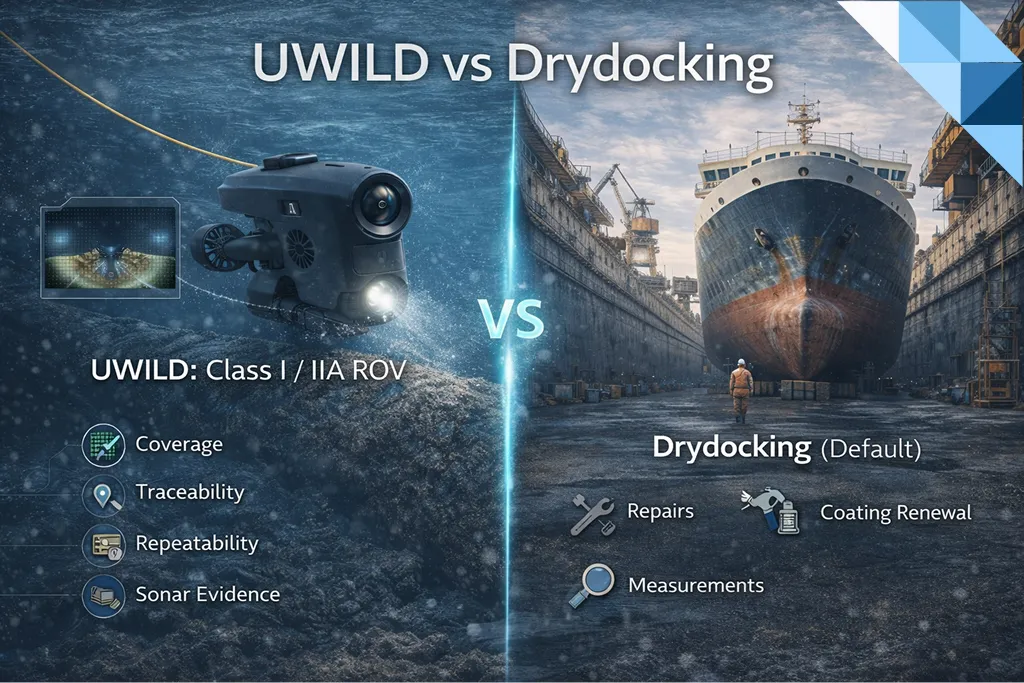
Draining reservoirs or isolating intakes is expensive, slow, and operationally disruptive. It introduces service risks, public impact, and regulatory complexity. In contrast, a disciplined no-drain ROV inspection allows utilities to:
- Keep assets online and operational
- Maintain potable water and hygiene compliance
- Produce evidence regulators, QA teams, and integrity engineers accept
- Base maintenance decisions on repeatable, traceable inspection data
Where programs fail is not “missing defects”—it’s failing to prove coverage, location, and repeatability. If visibility is poor or access is constrained, build your evidence strategy around coverage proof from the start using Multibeam & Imaging Sonar as Coverage Evidence so acceptance does not depend on “good optics.”
Inspection Scopes in Utilities, Dams & Intake Systems
A no-drain inspection program typically covers the following critical utility assets.
Trash-Racks & Bar Screens
- Bent or damaged bars
- Blockage load and debris accumulation
- Scour or undermining at bases
- Anode condition (where fitted)
If debris and fouling are recurrent issues, a staged approach usually works best: a fast screening pass to build a defensible exception list, followed by targeted close-ups at high-risk bays. This reduces field time while still producing decision-grade evidence compatible with Underwater Inspection (ROV) deliverables.
Intake Gates & Valves
- Seating surfaces and sealing condition
- Guides, tracks, and actuation linkages
- Corrosion or erosion in high-velocity zones
When decisions depend on “seal integrity” rather than “visual condition,” capture orthogonal passes and scale control early. If quantitative follow-up is needed, route the measurement work through repeatable subsea controls like those described in ROV-Deployed NDT (UT & CP) Best Practice to avoid one-off readings that cannot be defended later.
Conduits, Tunnels & Penstocks
- Sediment dunes and deposits
- Joint offsets and lining breakdown
- Biofouling and growth
- Air entrainment pockets
Long conduits are where “proof of access” becomes as important as findings. Lane design, overlap, time-coded media, and a clean evidence index are the difference between an accepted inspection and a repeat mobilization. If your program must operate in poor visibility, pair optical with sonar evidence from day one using Low-Visibility Sonar Coverage Proof.
Outfalls & Diffusers
- Nozzle integrity and alignment
- Diffuser caps and anchor points
- Seabed stability and scour
Where seabed interaction is a known driver, the same evidence logic used in pipeline corridor work applies: prove coverage at scale, then revisit only what drives engineering decisions. A good reference model for free-span/exposure logic and decision-led revisits is Underwater Pipeline Inspection: Free-Spans, Exposure & AUV→ROV NDT.
Ancillary Structures
- Ladders and access platforms
- Cathodic protection hardware
- Level sensors and attachments
Small attachments often drive big operational consequences. Capture stable IDs and time-coded evidence so operations can close actions without debating “where exactly is the issue.”
For each scope, the inspection should clearly state:
- Expected decision (clear, monitor, repair)
- Required evidence (scaled optical frames, sonar coverage, UT or CP where applicable)
If the scope is intended to drive lifecycle decisions and interval setting—not just a one-off check—connect outputs into an integrity workflow such as Asset Integrity Management so actions and intervals remain traceable to evidence.
Hygiene & Contamination Control for Potable Systems
In no-drain utility inspections, hygiene is non-negotiable. Water quality protection is as critical as asset integrity.
Core Hygiene Controls
- Pre-mobilization cleaning: disinfect ROV, tether, LARS, and tools using approved agents; document contact time and rinsing per potable standards.
- Barrier protocols: clean staging mats, dedicated totes, zero oil/grease shedding materials; leak-checked hydraulics or all-electric vehicles.
- Ingress control: launch downstream of treatment stages where possible; manage backflow risks; use sheath covers for tethers crossing decks.
- Consumables & PPE: potable-safe lubricants (if any), hair and beard nets where required, logged glove changes.
- Exception sampling: if sludge or unknown growth is disturbed, collect a small sample and log time/location for operations and laboratory follow-up.
All hygiene steps must be recorded in the inspection dossier so plant QA can close compliance quickly and confidently. If your QA team expects an auditable chain of hygiene controls, treat the hygiene log as part of the evidence pack, not an informal checklist—this is typically packaged alongside inspection deliverables in Underwater Inspection (ROV) campaigns.
Coverage & Safety in Confined Hydraulic Environments
Confined flows, debris, and hydraulic forces fundamentally change inspection tactics.
Operational Controls
- Flow & head management: coordinate with plant operations to reduce flow where feasible; define altitude and speed bands that prevent vehicle drift.
- Lane design: straight, constant-speed lanes with 20–40% overlap; add cross-lanes near racks, gates, and elbows to reduce shadow zones.
- Navigation aids: DVL / INS for station-keeping; in long tunnels, periodic fiducial “check segments” to bound drift.
- Low-visibility mode: use imaging sonar for near-field structures and multibeam for long conduits; tag hits for later optical CVI revisits when clarity permits.
- Debris & entanglement control: pre-survey hazard registers (wires, ropes, netting); install guards where required; define recoverable tether routes and hard abort criteria.
If your acceptance depends on proving where the vehicle actually went (not only what the camera saw), follow an evidence workflow built around coverage certainty such as Multibeam & Imaging Sonar as Coverage Evidence.
Actionable Reporting for Utility Operations (Not Just Video)
Operations teams do not want terabytes of footage—they want a clear, defensible worklist.
Minimum Actionable Outputs
- Exception register: each item with ID, location reference (chainage, bay, rack position), severity, root-cause hypothesis, and recommended action (clear, repair, monitor).
- Scaled frames & clips: time-coded stills and video with laser scale or known reference, plus a short caption explaining why it matters.
- Coverage map: simple plan showing completed lanes, pending zones, and revisit points.
- Cleaning log & debris index: what was removed, where it was staged, and disposal notes.
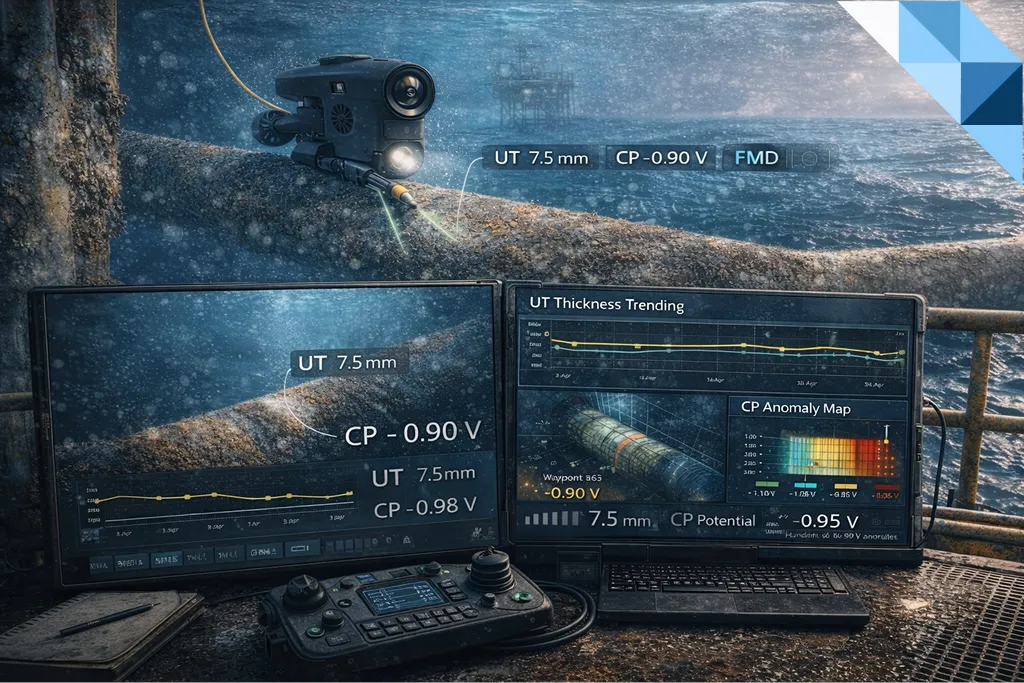
- UT / CP records (where applicable): thicknesses or potentials with calibration references; electrode placement shown on frame for CP; probe contact documented for UT.
Keep the core report concise—typically 5–8 pages, with media links in an annex. Faster close-out means fewer return visits.
If you want an evidence workflow that compresses review time without weakening traceability, connect optical and sonar streams into a single reviewable package as described in AI-Assisted ROV Inspection. Used correctly, it accelerates screening while preserving the evidence chain owners and reviewers expect.
RBI Cadence for Utility Assets
A no-drain inspection program only delivers value when findings feed directly into RBI-based planning.
Key RBI Elements
- Baseline: define consequence classes and degradation mechanisms (debris loading at racks, cavitation near gates, corrosion at splash zones, sediment transport in tunnels).
- Intervals: start conservatively (e.g., annual racks/gates, 2–3 year tunnels), then extend or shorten based on stable evidence trends.
- Special inspections: trigger focused re-inspections after floods, extreme turbidity events, debris influx, or high differential-head alarms.
- KPIs: blockage percentage vs design, time-to-clear, recurring anomaly rate per bay, CP potentials vs targets, UT trends at high-velocity locations.
- Governance: version the RBI model and maintain a traceable chain from each interval decision back to inspection media, IDs, calibration records, and plant events.
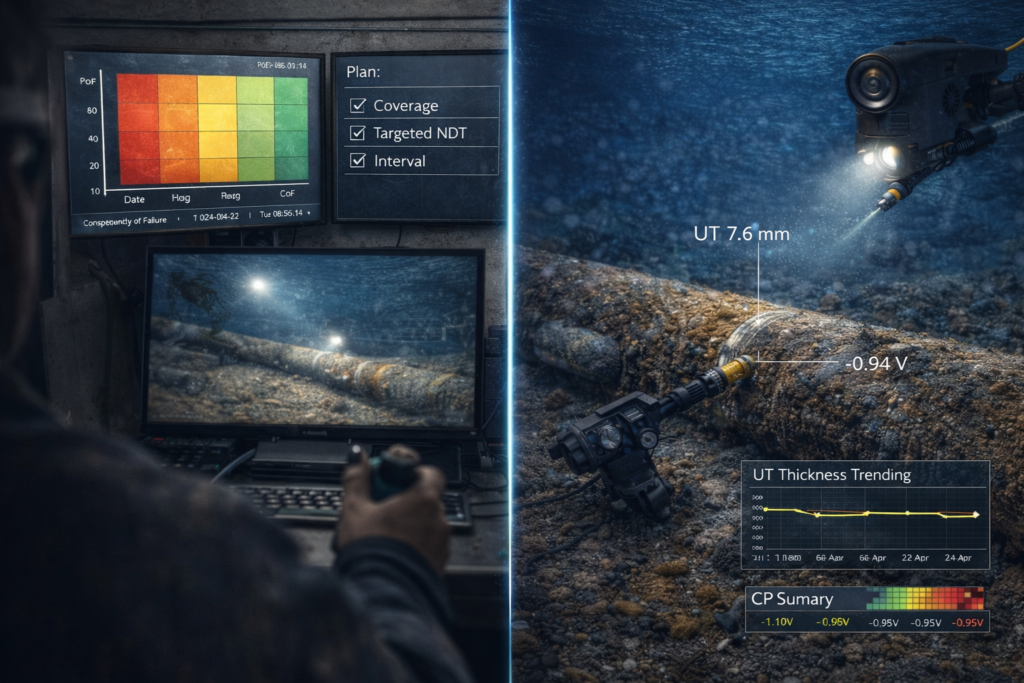
If you’re using inspection outcomes to justify interval changes, make the decision chain explicit: why the interval changed, which evidence supports it, and what triggers will force a re-check. That decision discipline sits naturally inside Risk-Based Inspection (RBI) and broader Asset Integrity Management governance.
Practical Capture Rules for Utility Inspections
- Lighting: main plus angled fill to reduce glare on glossy coatings and reveal weld toes; use shrouds near silt to limit backscatter.
- Stand-off discipline: remain within the lens sweet spot; avoid contact with racks, liners, or coatings.
- Lane housekeeping: name lanes; log UTC start/stop; keep speed constant; avoid hovering except at predefined fiducials.
- Pre/post evidence: when recommending cleaning or repair, capture brief before/after sequences to support planning and verification.
- Time synchronization: align camera, sonar, and overlays to a single UTC source; store offset logs in the report.
Where measurement or verification is required, use repeatable controls. For UT/CP discipline that holds up in reviews, anchor measurement workflows to ROV-Deployed NDT (UT & CP) Best Practice rather than relying on ad-hoc data capture.
Table — No-Drain Intake Inspection: Plan → Execute → Accept
Stage: Plan
What you do: Define lanes, overlap, flow settings, hazard register, hygiene steps
Evidence you keep: Lane grid, SOPs, hygiene checklist, abort criteria
Stage: Execute
What you do: Fly constant-speed lanes; tag debris and defects; sonar where visibility drops
Evidence you keep: Time-coded clips, scaled frames, sonar mosaics with tags
Stage: Revisit
What you do: Optical CVI and targeted UT / CP where required
Evidence you keep: Paired sonar hit ↔ optical/NDT media
Stage: Report
What you do: Exception list, coverage map, cleaning and debris log
Evidence you keep: Register (CSV/XLSX), media list, calibration records
Stage: Close
What you do: Feed results into RBI; set next interval or specials
Evidence you keep: Decision note with traceable inputs
FAQs
Can we maintain potable certification while using an ROV?
Yes—provided documented hygiene protocols are followed (approved disinfectants, contact times, clean staging, leak-checked vehicle) and fully logged for plant QA.
What overlap is appropriate for intakes and tunnels?
Typically 20–40% between lanes, increased for cluttered geometry or high-flow conditions. Cross-lanes near racks and elbows reduce shadow zones.
How should poor visibility be handled?
Use imaging or multibeam sonar for coverage proof, tag anomalies precisely, and return for optical CVI when clarity allows. A practical evidence approach is outlined in Multibeam & Imaging Sonar as Coverage Evidence.
What makes a report actionable for operations?
A short exception register with IDs, clear location references, severity, and a defined action—each backed by scaled frames and time-coded clips.
How do inspection results affect maintenance schedules?
Stable evidence feeds directly into RBI: recurring blockages or degradation shorten intervals, while clean runs and stable KPIs justify extensions. If you’re formalizing that logic, start with Risk-Based Inspection (RBI) and keep the decision trail governed under Asset Integrity Management.
Keep Production Online
No-drain ROV inspections only work when hygiene, coverage certainty, and reporting are built into one coherent evidence package. NWE supports planning and delivery of acceptance-grade underwater evidence through Underwater Inspection (ROV), with full context available under Inspection Services.

2 Responses
We run municipal intakes and draining is basically political suicide. If you do a first-pass screening inspection, what’s the minimum deliverables pack you recommend so engineers can decide next actions without another mobilization?
Love the ‘keep assets online’ angle. Are you open to partnering with local contractors for remote municipalities? We handle access/permitting and could use a specialist ROV evidence workflow.