Risk-Based Inspection (RBI) – API 580 / API 581

Smarter inspections, lower risk, better use of budget

Traditional time-based inspection treats all equipment the same, regardless of how likely it is to fail or what the consequences would be. Risk-Based Inspection (RBI) does the opposite: it focuses your limited inspection resources where probability of failure (PoF) and consequence of failure (CoF) are highest.

NWE provides independent RBI services aligned with API 580 and API 581, helping asset owners move from calendar-driven inspection to risk-driven inspection programmes that are defensible, practical and standards-based.

Our RBI support helps you:

  • Reduce unplanned failures and HSE exposure
  • Eliminate low-value inspections and focus on high-risk equipment
  • Justify inspection intervals to regulators and corporate governance

When Do You Need Risk-Based Inspection (RBI)?

RBI becomes essential when time-based inspection is no longer enough to balance safety, cost and uptime.

Typical triggers include:

  • Growing inspection backlog and limited budget

    • Too many items on fixed intervals, not enough resources to do them all

    • Difficulty explaining to management why some items may be inspected less often

  • Complex plants and ageing assets

    • Refineries, petrochemical plants and terminals with thousands of equipment items

    • Assets beyond original design life where degradation and uncertainty are increasing

  • Regulatory or corporate expectations for risk-based decisions

    • Authorities or corporate standards referencing API 580/581 for inspection planning

    • Internal audit findings asking for risk-based justification for inspection intervals

  • Desire to link inspection to real risk, not just time

    • Management wants to know “where the real risk lives” across vessels, piping and tanks

    • Need to coordinate RBI with FFS, RBI-related software and integrity KPIs

In these situations, RBI provides a structured, API 580/581–aligned way to decide what to inspect, how often and with which methods, based on quantified or semi-quantified risk instead of fixed calendars.

NWE’s RBI work is focused on implementable inspection plans and clear risk communication, not just risk matrices or software outputs.

A typical NWE RBI engagement delivers:

  • Risk ranking of equipment

    • Probability of failure (PoF) estimated using degradation mechanisms, condition data and design margins

    • Consequence of failure (CoF) evaluated across safety, environmental, production and financial impacts

  • Risk-based inspection plans and intervals

    • Inspection intervals and methods (e.g. UT, RT, EC, visual, on-stream) defined according to risk, not arbitrary frequency

    • Clear differentiation between high-risk and low-risk items, enabling reallocation of inspection resources

  • Damage mechanisms and data requirements identified

    • Mapping of applicable damage mechanisms per equipment class and service

    • Data requirements aligned with API 580/581 and NWE’s published guidance on RBI inputs and data quality

  • Integration with existing inspection and integrity systems

    • RBI outputs formatted so they can be used within client CMMS/IMS and RBI software tools (e.g. API 581-based solutions such as DNV Synergi RBI, Antea, and similar)

  • Audit-ready documentation

    • Transparent records of assumptions, risk criteria, data sources and decision logic

    • Documentation that supports regulator, corporate and insurer reviews

The result is a risk-based inspection plan that is traceable, defendable and actually usable by inspection and operations teams.

NWE’s RBI services are tailored for pressure equipment and piping in energy and process industries, aligned with the typical scope of API 580/581.

Typical assets included in RBI scope:

  • Pressure vessels, columns, drums and reactors

  • Process and utility piping systems

  • Storage tanks and spheres

  • Heat exchangers and coolers

  • Relief devices and associated piping where applicable

Typical damage mechanisms considered (depending on service and materials):

  • General and localised corrosion

  • Erosion–corrosion and flow-accelerated corrosion

  • High-temperature damage (creep, HTHA where applicable)

  • Environmentally assisted cracking (HIC/SOHIC, SCC, fatigue-related mechanisms)

  • Temperature cycling and pressure cycling effects

For specific flaws or complex loading control risk, RBI is linked with Fitness-for-Service (FFS) and Engineering Critical Assessment (ECA) to provide defect-level evaluations.

NWE is not a software vendor or inspection-only provider trying to fill the calendar. We combine independent accreditation with a balanced view of inspection, integrity and engineering.

  • Independent, accredited inspection and engineering company
    Nord Welding & Engineering AS is accredited under ISO/IEC 17020:2012 as an independent inspection body and operates certified ISO 9001, ISO 14001 and ISO 45001 management systems.

  • Clear separation – inspection vs engineering
    NWE explicitly separates third-party inspection services from asset-integrity engineering and RBI work, supporting impartiality and reducing conflicts of interest.

  • Deep RBI knowledge reflected in public guidance and training
    NWE publishes practical content on RBI vs TBI, API 580/581 data requirements and risk-based integrity decision-making, and supports training initiatives through partners like NTIA.

  • Integrated with FFS, integrity and inspection services
    RBI outputs are designed to feed into FFS assessments, Pipeline/Equipment Integrity Assessments and in-service inspection programmes, making sure that risk decisions match real inspection and repair actions.

  • Technology-neutral, standards-based approach
    NWE can work with client-selected RBI software (API 581-based or otherwise) and internal standards, as long as the approach remains consistent with API RP 580/581 principles.

For asset owners, this means RBI programmes that are technically sound, operationally realistic and aligned with both international standards and local expectations.

Want to reassess your current inspection strategy?
Get in touch with NWE to discuss how RBI can be implemented or improved at your site.

RBI is a cornerstone of NWE’s Asset Integrity Management offering and naturally links with:

  • Fitness-for-Service (FFS) – defect-level evaluation to API 579 / ASME FFS-1

  • Pipeline Integrity Assessment – risk and condition assessment for pipelines

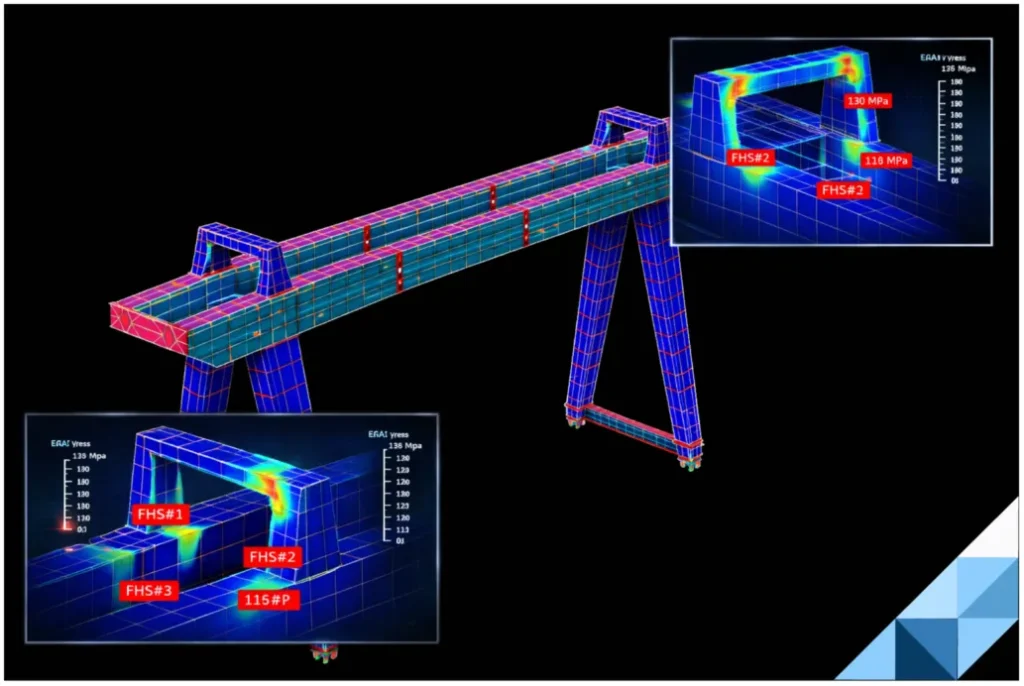
  • Structural Integrity Assessment – capacity and risk evaluations for structures

  • Piping & Pipeline Stress Analysis – mechanical behaviour and load verification

  • In-Service Inspection & NDT – data gathering that feeds RBI programmes

These services together ensure that inspection effort, engineering evaluations and risk decisions stay aligned over the life of your assets.

Need RBI support?

Get in touch with NWE experts

Our Projects & Engineering Solutions

Explore real-world projects showcasing our expertise, innovation, and commitment to client success.

Risk-Based Inspection (RBI) – Frequently Asked Questions

Q1. What is the difference between RBI and time-based inspection (TBI)?

 Time-based inspection follows fixed intervals (for example every 3 or 5 years) regardless of actual risk. RBI uses risk = PoF × CoF as the organising principle: high-risk equipment gets more frequent or more detailed inspection, while low-risk items may justifiably be inspected less often.

 NWE aligns its RBI work with API RP 580 (programme elements) and API RP 581 (quantitative RBI methods), and harmonises outputs with client standards, regional regulations and any chosen RBI software environment.

 At minimum, you need an equipment list with basic design data, process conditions, materials, inspection history and known damage mechanisms. Higher-quality RBI requires more detailed inspection results, corrosion studies and failure/consequence data. NWE’s own guidance on API 580/581 RBI data requirements can be used as a checklist.

 Yes—for low-risk items where PoF and CoF are demonstrably low and properly documented, RBI can justify longer inspection intervals or simpler techniques. At the same time, it often increases focus on a smaller set of high-risk items. The net effect is usually fewer low-value inspections and more targeted inspections where it matters.

 RBI defines where and how often you should inspect based on risk. When inspections reveal significant flaws, FFS and integrity assessments (for example API 579 evaluations) are used to decide whether assets can continue in service, under what limits and for how long. RBI then uses those results to update risk and inspection plans.

Risk-Based Inspection (RBI) service Request

Please provide the following information to request our company services

 We’re excited to connect with you and share more about how we can collaborate together!