

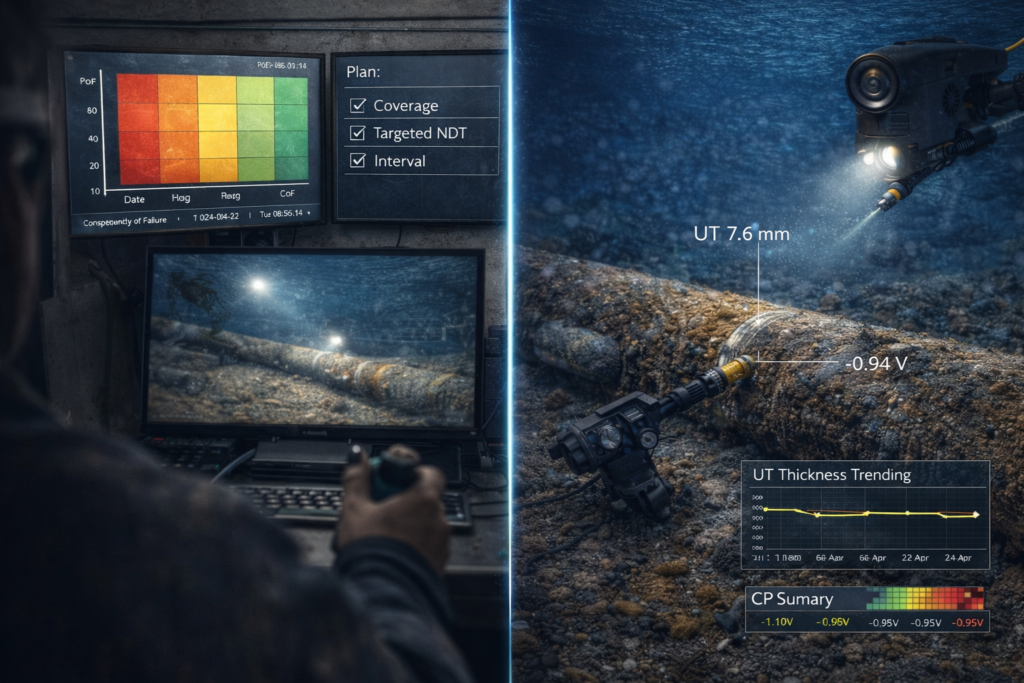

Subsea assets don’t fail on calendar dates—they fail when damage mechanisms progress faster than the evidence you collect. Risk-Based Inspection (RBI) turns that reality into a defendable plan: you rank segments by Probability of Failure × Consequence of Failure (PoF×CoF), then translate the ranking into inspection coverage (GVI/CVI/DVI), targeted NDT, intervals, and trigger rules.
If you need a clean “decision logic” baseline for how RBI differs from fixed-interval planning, use:
Risk-Based Inspection vs Time-Based Inspection: Methodology Guide
What RBI/SIM Delivers in a Subsea Context
A working subsea RBI/SIM program produces outcomes that can survive review:
- Risk register by system/segment (PoF×CoF, dominant threats, uncertainty score)
- Method selection logic (why GVI/CVI/DVI and which NDT where)
- Intervals + triggers (what changes the plan, and how fast you respond)
- Audit-ready evidence pack (traceable IDs, calibrated measurements, time-coded media, exception closure)
The difference between “a report” and “a defendable program” is almost always the data model and governance, not the math.
Standards Framework (Keep ISO with ISO, API with API)
Subsea integrity programs often operate under one of two parallel standards “families.” The key is to keep references consistent inside the chosen family—no cross-mapping.
API family (American package)
- Design: API RP 2A-WSD and API RP 2A-LRFD
- SIM (Structural Integrity Management): API RP 2SIM
ISO family (international package)
- Design: ISO 19901 series and ISO 19902
- SIM (Structural Integrity Management): ISO 19901-9
In practice: if the contractual/regulatory environment is ISO-led, anchor SIM discussions in ISO 19901-9. If it’s API-led, anchor SIM discussions in API RP 2SIM—but present them as parallel frameworks, not clause-to-clause equivalents.
Start With the RBI Data Model (Before You Argue About Intervals)
Most RBI debates collapse because inputs are incomplete or inconsistent. Build a minimum model that is traceable, reviewable, and updateable.
A practical starting dataset:
- Asset hierarchy (system → segment → component) with stable location IDs
- Consequence class (safety, environment, production, reputation)
- Dominant threats and credible mechanisms (corrosion, fatigue, impact, geohazards, free spans, coating damage, CP anomalies)
- Evidence library (visual coverage + measurements where trending matters)
- Uncertainty score (coverage gaps, access constraints, low confidence evidence)
- Exception register (finding severity, owner, due date, closure evidence)
- Interval rule + triggers (what changes PoF/CoF or uncertainty)
A solid inputs checklist and governance logic is summarized here:
RBI Data Requirements (API 580/581): Build a Model You Can Defend
Turning Risk Into Scope: GVI/CVI/DVI + Targeted NDT
Once you know the dominant threats, inspection depth becomes a decision—not a habit.
How scope typically scales
- GVI (General Visual Inspection): broad screening, access/condition confirmation, obvious anomalies
- CVI (Close Visual Inspection): targeted areas where PoF/uncertainty is higher
- DVI (Detailed Visual Inspection): critical details, joints, welds, interfaces, or locations with confirmed indications
NDT selection (principle)
Use NDT where it meaningfully reduces uncertainty or confirms progression (e.g., thickness trending in credible corrosion zones, confirmation checks on anomalies, or verification on critical details). The goal is not “more NDT”—it’s decision-grade NDT.
When UT thickness and CP surveys are part of the integrity decision loop, repeatability and traceability are the whole game. Practical execution controls for repeatable results are covered here:
ROV-Deployed NDT in Practice: UT & CP That Deliver Repeatable, Class-Ready Results
NORSOK U-102 Lens: Make Underwater Evidence Reviewable
A subsea program becomes “class-ready” when the evidence is packaged so a third party can review it without interpretation gaps. Under a NORSOK U-102 way of thinking, your underwater campaign should make these things easy to verify:
- What was inspected (scope + coverage proof)
- Where it was inspected (location IDs tied to drawings/model)
- How it was inspected (method statement, equipment, constraints)
- What was measured (units, calibration/verification records, repeatability controls)
- What was found (findings with severity and disposition path)
- What changed in risk (updated PoF/CoF/uncertainty and interval logic)
This is exactly why the evidence pack matters as much as the inspection itself.
ROV Capability Statement (Set Expectations Correctly)
For many subsea assets, the safest and most scalable way to collect visual evidence—and selected measurements—is with ROV deployment. Our underwater inspection capability is based on ROV Class I and Class IIA systems (not work-class ROVs). That means:
- Strong fit for: visual surveys (GVI/CVI), coverage proof, condition screening, and selected measurement tasks within tooling limits
- Clear boundary: tasks that require heavy intervention tooling or high-power work-class manipulation must be planned differently (or supported by alternative methods)
This capability clarity improves planning accuracy and prevents scope creep during integrity campaigns.
Intervals and Trigger Rules That Hold Up in Reviews
Intervals should be conditional, not static. Set a base cadence by consequence and uncertainty, then define triggers that pull work forward when trends deteriorate.
Typical trigger examples (you tailor thresholds to your assets and risk appetite):
- Accelerating thickness loss trend (UT slope threshold exceeded) → targeted verification + earlier revisit
- Persistent CP anomaly across campaigns → verification + corrective action study + interim checks
- Event-driven risk (impact, storm exceedance, dropped object, abnormal operations) → special inspection linked to event footprint
- Repeated anomalies in a critical location → escalate inspection depth (CVI → DVI) and engineering disposition
Trigger rules reduce argument: the plan already defines “what happens next.”
Audit-Ready Deliverables (What Reviewers Actually Need)
A practical deliverables bundle for subsea RBI/SIM should include:
- Scope and coverage statement (what/where/how much)
- Time-coded video + stills, indexed to location IDs
- Measurement tables (where applicable) linked to IDs and timestamps
- Verification/calibration records for data used in trending decisions
- Findings list + exception register (severity, owner, due date, closure evidence)
- A short decision memo: what changed, why, and what interval is now justified
This keeps integrity decisions transparent and defensible under either ISO 19901-9 or API RP 2SIM governance.
Case Proof: How Evidence Drives Decisions Under Constraints
To see how subsea evidence supports rapid, defensible recommendations in a real execution scenario, review:
NWE Subsea Inspection of 24-Inch River-Crossing Pipeline
FAQ
What is ISO 19901-9 and where does it fit?
ISO 19901-9 is the ISO-series reference for Structural Integrity Management (SIM) for offshore structures. In an ISO-led standards regime, it provides the SIM governance frame—how integrity evidence, findings, review cycles, and decision logic are managed across the lifecycle.
Is ISO 19901-9 the “same as” API RP 2SIM?
They serve similar SIM intent (governed integrity decisions for offshore structures), but they belong to different standards families. In documentation, keep references consistent: ISO-to-ISO and API-to-API, without clause-by-clause cross-mapping inside one document.
Can RBI reduce cost without increasing risk?
Yes—when it reduces low-value repeat inspections in demonstrably low-risk zones and concentrates effort on high-consequence or high-uncertainty segments, while keeping evidence quality and traceability high.
Ready to Make Subsea RBI Decisions Stick?
If you want inspection budgets to follow risk—and deliverables that owners and reviewers can accept without back-and-forth—start with the data model, define trigger rules, and execute underwater campaigns that produce reviewable evidence from day one.
Underwater inspection capability overview:
https://nwegroup.no/inspection/underwater-inspection/

One Response
Are there more information regarding about this topic for us to research for?