What-is-piping
dot

Piping Stress Analysis Services

Ensure safe, code-compliant piping systems in process and power plants

In process plants and power facilities, piping is where thermal movements, weight, pressure and equipment loads all meet. If stresses and displacements are not properly controlled, the result can be overstressed lines, overloaded nozzles, vibration problems and unplanned shutdowns.

NWE provides independent Piping Stress Analysis services to verify that process and utility piping systems are safe, flexible and code-compliant under real operating conditions. 

Our work helps EPCs, plant owners and operators:

  • Confirm code compliance before fabrication and commissioning
  • Protect pumps, turbines, vessels and heat exchangers from excessive nozzle loads
  • Avoid costly rework and schedule risk during MOC and revamp projects

Need expert validation of your piping system design? Request

Piping Stress Analysis is required whenever loads, temperatures or layout changes could challenge the integrity or compliance of a piping system.

Typical triggers include:

  • New unit design and brownfield tie-ins

    • New process units, utility systems and offsite piping

    • Tie-ins to existing lines, rerouted headers and new branches

    • Vendor skid tie-ins and rotating equipment connections

  • High-temperature and cyclic service

    • Hot process and steam lines subject to expansion and contraction

    • Frequent start–stop or temperature cycling that can drive fatigue

  • Equipment protection and nozzle loads

    • Pumps, compressors, turbines and vessels with strict allowable loads

    • Vendor comments on excessive forces and moments at nozzles

  • Layout and support challenges

    • Long spans, crowded racks or complex 3D routing around other equipment

    • Changes to support types, locations or flexibility loops

  • Integrity and reliability concerns

    • Recurring support failures, leaks at welds or observed vibration

    • Life-extension studies or integration with FFS and RBI programmes

In these situations, a structured ASME B31-based piping stress analysis gives you evidence-based answers, rather than relying on rules of thumb or visual judgement.

NWE’s Piping Stress Analysis is focused on decision-ready outputs, not just software files. A typical assignment delivers:

  • Load cases and stress checks under real conditions
    We evaluate sustained, expansion and occasional load cases in line with ASME B31.3/B31.1 and project standards, including:

    • Weight and pressure (pipe, fluid, insulation, fittings)

    • Thermal expansion and contraction across operating cycles

    • Occasional loads such as wind, seismic and surge / water hammer

    • Displacement effects from settlement, support movement and equipment nozzles

  • Code compliance and nozzle load verification
    Stresses and displacements are checked against:

    • ASME B31.3 Process Piping, ASME B31.1 Power Piping and relevant EN/ISO codes

    • Allowable nozzle loads from API-based equipment standards and vendor data, where available

  • Support and flexibility optimisation
    We review and, where needed, propose adjustments to:

    • Support types and locations (anchors, guides, line stops, spring hangers)

    • Expansion loops, offsets and routing details to improve flexibility and reduce nozzle loads

  • Clear recommendations and mitigation options
    Findings are translated into practical actions such as support changes, loop additions, routing refinements or operating envelope notes, so design and operations teams know exactly what to do.

  • Audit-ready documentation
    Reports include assumptions, load cases, stress summaries, nozzle check tables and support lists, prepared in a format suitable for internal reviews, regulators and third-party audits.

The objective is straightforward: a piping system that is demonstrably safe, flexible and compatible with connected equipment.

NWE focuses on industrial piping systems where stress behaviour and nozzle loads directly affect safety, reliability and compliance.

Typical systems and sectors:

  • Process and utility piping in oil & gas, petrochemical and refinery plants

  • Power and energy piping, including HRSG, steam and condensate systems

  • Chemical, pharmaceutical and specialty manufacturing units

  • Water, wastewater and utility networks within industrial sites

Typical conditions:

  • High-temperature, high-pressure and cyclic service lines

  • Jacketed, cryogenic and specialty piping with demanding flexibility needs

  • Lines connected to sensitive rotating equipment and static vessels

  • Revamp, MOC and life-extension projects with mixed old and new piping

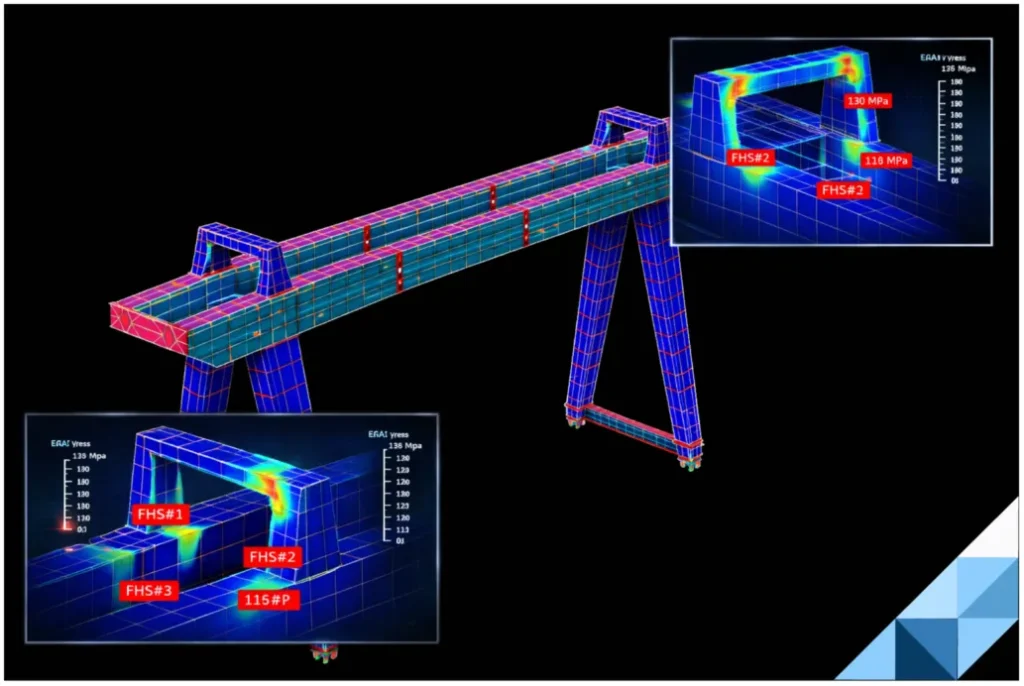
Where local details control behaviour (e.g. special fittings, complex branches, local high-stress regions), CAESAR II models can be supplemented with targeted FEA to capture local stress and strain more accurately.

NWE combines independent accreditation with deep experience in piping, inspection and asset integrity.

  • Accredited and certified organisation
    Nord Welding & Engineering AS is accredited under NS-EN ISO/IEC 17020:2012 as an independent inspection body and operates certified ISO 9001, ISO 14001 and ISO 45001 management systems, providing a robust quality and governance framework for all engineering work.

  • Code-based, tool-enabled engineering
    Our piping stress work is anchored in ASME B31.3, ASME B31.1 and relevant EN/ISO standards, using industry-standard tools such as CAESAR II and complementary FEA where appropriate. This aligns NWE’s services with leading pipe stress practices worldwide.

  • Independent third-party perspective
    NWE is not a fabricator or EPC contractor. As an accredited third-party, our role is to verify, challenge and document results objectively, reducing bias and providing confidence to owners, regulators and insurers.

  • Integrated with integrity, FFS and RBI services
    Piping Stress Analysis is delivered in the context of NWE’s broader Asset Integrity Management offering, so stress results can feed directly into Fitness-for-Service (FFS), Risk-Based Inspection (RBI) and Structural / Pipeline assessments where needed.

For clients, this means piping stress studies that are technically robust, traceable and aligned with overall integrity strategy, not just stand-alone calculations.

Piping Stress Analysis is often combined with other NWE services, including:

  • Fitness-for-Service (FFS) Assessments – local defect evaluation to API 579 / ASME FFS-1

  • Risk-Based Inspection (RBI) – risk-informed inspection planning for piping and static equipment

  • Structural Integrity Assessment – global assessment of supporting structures and frames

  • Structure Stress Analysis – detailed stress checks for racks and supports carrying piping

  • Pipeline Stress Analysis – mechanical assessment of cross-country and subsea pipelines

  • Pipeline Integrity Assessment – condition and risk evaluations based on inspection data

These services ensure that piping, pipelines, supports and inspection plans are evaluated coherently across your assets.

 Contact NWE or request a piping stress analysis before you commit to fabrication or startup.

Our Projects & Engineering Solutions

Explore real-world projects showcasing our expertise, innovation, and commitment to client success.

Piping Stress Analysis – Frequently Asked Questions

Q1. How is Piping Stress Analysis different from Pipeline Stress Analysis?

 Piping Stress Analysis focuses on plant and facility piping – shorter, more complex systems governed mainly by ASME B31.3 and B31.1, with a strong focus on nozzle loads and flexibility around equipment. Pipeline Stress Analysis addresses long-distance transmission lines, typically under ASME B31.4/B31.8 and ISO pipeline standards, with more emphasis on soil–pipe interaction and route-level behaviour.

 For most industrial projects we work primarily to ASME B31.3 (Process Piping) and ASME B31.1 (Power Piping), alongside EN 13480, PED and project-specific standards where applicable. Where local stresses or defect evaluations are involved, results can be aligned with API 579 / ASME FFS-1 as part of FFS assessments.

 Done properly, piping stress analysis supports both safety and optimisation. It helps avoid over-stiff designs, unnecessary materials, and late rework, while protecting equipment and meeting code. For many plants, this translates into fewer shutdowns, fewer site changes and a more efficient layout over the life of the unit.

 Both. For new designs, we verify that layouts, supports and flexibility meet code and vendor limits before fabrication. For existing systems, we assess stress behaviour after modifications, support changes or integrity findings, and recommend practical measures for safe operation and life extension.

Piping Stress Analysis Service Request

Please provide the following information to request our company services

 We’re excited to connect with you and share more about how we can collaborate together!