

Ensure Safety, Compliance & Long-Term Reliability – with NWE Experts
Pipelines are exposed to pressure cycles, temperature changes, soil movement, wind, waves and occasional events such as seismic loads or surge. If the combined stresses are not properly evaluated and controlled, the result can be excessive movement, loss of containment or fatigue damage over time.
NWE provides independent Pipeline Stress Analysis services for onshore, offshore and buried transmission systems. We evaluate mechanical and thermal stresses in your pipeline under real operating and extreme conditions, and check them against the relevant design codes and standards.
Our work helps you:
Pipeline stress analysis is the structured evaluation of stress, strain and displacement in a pipeline system under all relevant load cases—operating, transient and occasional. Typical load categories include:
The objective is to confirm that calculated stresses and movements remain within allowable limits from the applicable design codes and project criteria, and that the system can operate safely over its intended life without unacceptable fatigue, vibration or loss of containment.
You typically need a formal pipeline stress analysis when any of the following apply:
In these situations, stress analysis is not optional; it is required by codes and by good engineering practice to support safe, compliant operation.
NWE’s service is built as a full engineering package—not just a software run.
We build a model of your pipeline system and evaluate it under all relevant load cases, such as:
The results are checked against the governing standards—for example ASME B31.4 (liquid pipelines), ASME B31.8 (gas transmission and distribution), ISO 13623 and relevant national regulations, plus project-specific criteria.
We confirm that:
Where non-compliance or marginal conditions are found, we recommend practical mitigation options—support changes, expansion loops, flexibility redesign, profile adjustments or operating limits.
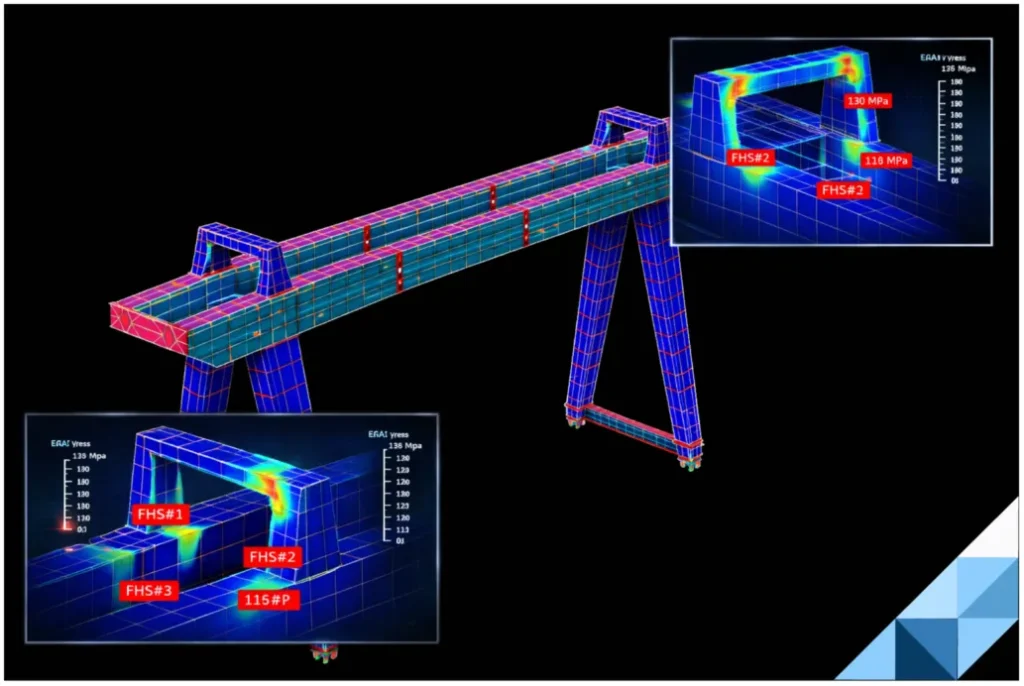
NWE uses CAESAR II and equivalent industry-standard tools as the baseline for pipeline stress calculations, and extends them with Finite Element Analysis (FEA) when more detailed local assessment is needed—for example at critical fittings, complex branch connections, special supports or tie-ins.
This combination allows us to capture:
You receive structured outputs that can be used directly by:
Reports are prepared to be decision-ready, not just a collection of raw software printouts.
NWE’s Pipeline Stress Analysis covers a wide range of systems:
Pipeline types
Typical load and design challenges
NWE is more than a software user; it is an independent, accredited inspection and asset-integrity engineering company with a strong track record in pipeline projects.
Pipeline Stress Analysis is part of NWE’s wider Asset Integrity Management offering and typically connects to:
These services can be combined into a coherent pipeline integrity programme covering condition, stress, risk and inspection.
Need to verify a new design or reassess an existing pipeline?
Contact NWE or request a Pipeline Stress Analysis package for your project.
Explore real-world projects showcasing our expertise, innovation, and commitment to client success.
For pipelines we primarily use ASME B31.4 (liquid pipelines) and ASME B31.8 (gas transmission and distribution), together with ISO 13623 and applicable national regulations. Where pipelines interface with process facilities, relevant piping codes such as ASME B31.3 are also considered.
Yes. Any modification, rerouting, support change, uprating or evidence of movement can significantly change the stress picture. A post-commissioning stress review is often required to support integrity assessment, FFS or RBI updates for ageing assets.
We use CAESAR II and equivalent pipeline stress tools for global modelling and code checks, and supplement these with Finite Element Analysis (FEA) for complex local problems, special fittings and detailed pipe–soil or support interaction where necessary.
Yes. NWE routinely integrates pipeline stress results into Fitness-for-Service (API 579 / ASME FFS-1) evaluations and Risk-Based Inspection models, helping you prioritise inspections and mitigation actions where stress and defect risk are highest.
We’re excited to connect with you and share more about how we can collaborate together!
Please contact us to discuss your staffing requirements and explore how NWE can assist in achieving your project objectives
NWE provides independent third-party inspection services and separate asset-integrity engineering support—improving quality and safety, protecting operations and budgets, and enhancing environmental performance.