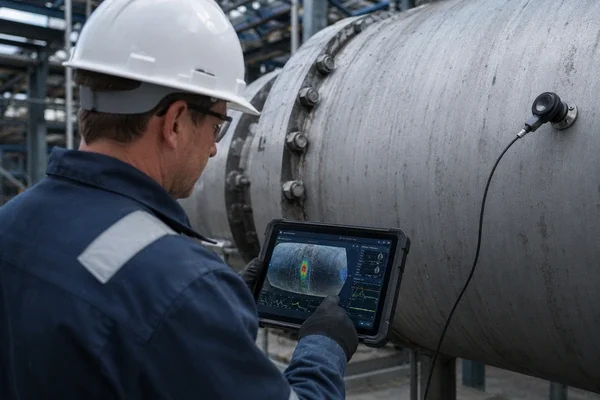

No. Artificial intelligence cannot replace the qualified people and authorized engineering roles responsible for pressure-equipment inspection and integrity decisions. It can assist bounded tasks—such as screening images, locating candidate indications, comparing repeat inspections, checking coverage and structuring records—when the data, task, model and reviewer workflow have been controlled.
The important question is not whether a model is “accurate.” It is whether the system has been qualified for a defined inspection task and operating envelope, whether missed conditions are understood, whether a competent reviewer can challenge and override the output, and whether the verified evidence remains traceable into the applicable acceptance or engineering process.
Key Takeaways
- AI can accelerate repetitive screening and data-handling tasks, but a flag is not an accepted indication or an integrity decision.
- Model performance must be evaluated for the selected method, defect or condition class, equipment geometry, acquisition setup and field environment.
- Accuracy, precision, recall, confidence score and Probability of Detection answer different questions and should not be used interchangeably.
- Human oversight needs competence, authority, override and a safe manual fallback—not a ceremonial final signature.
- A controlled deployment needs raw-data traceability, model/version control, reviewer records, change management and revalidation triggers.
Can AI Replace the Pressure Equipment Inspector?
AI may assist the inspection workflow, but it does not remove the personnel, procedure and authorization requirements that apply to the work. The reviewer still needs to understand the inspection method, the equipment, the likely damage or condition, the limitations of the acquired data and the consequences of a missed indication.
ASTM E3327/E3327M provides a useful example of this boundary. Its published scope addresses software used to assist identification of indications in digital radiographic images. The guide frames assisted defect recognition as support for a human operator; it does not turn the algorithm into an unaided final disposition authority. Some concepts may inform other digital NDT tasks, but the standard’s exact scope should not be generalized to every inspection method.
The authority chain should remain visible: software produces a candidate or structured output; qualified inspection personnel verify the evidence and apply the approved review process; authorized roles apply acceptance criteria; and engineers or owners make separate integrity decisions where FFS, RBI, repair or operating limits are required.
What AI-Assisted Inspection Actually Means
AI-assisted inspection means using a model to support one or more defined steps in the review of inspection data. The output may be a ranked queue, a highlighted region, a segmentation mask, a similarity match, a change alert, a coverage warning or extracted metadata. It is not automatically a valid defect characterization or an approved action.
This distinction prevents a common failure: combining data capture, indication review, acceptance and engineering disposition into one “AI inspection” claim. Those activities use different evidence, competence and approval rules. A useful implementation states exactly which step the model assists and which steps remain outside its intended use.
NWE’s AI-assisted ROV inspection article uses the same screen–verify–decide principle in a subsea context. It is a workflow analogy, not proof of a pressure-equipment AI product or transferable performance.
Tasks That Suit Automation—and Tasks That Do Not
AI is most useful where the inputs and outputs are bounded, repeatable and reviewable. It becomes harder to control when the task requires broad context, uncertain evidence, code interpretation or engineering judgement.
| Task | AI-assisted role | Required human role | Decision boundary |
| Image or signal screening | Rank or flag candidate regions for review | Qualified reviewer verifies candidates and considers missed-condition risk | A flag is not acceptance or disposition |
| Segmentation / localization | Outline a probable region, feature or indication | Reviewer confirms component, location and relevance | Sizing and acceptance require the applicable method and procedure |
| Like-for-like matching | Align comparable records or repeat locations | Reviewer confirms true comparability and acquisition differences | A detected change does not automatically prove degradation |
| Change detection | Highlight differences between campaigns | Reviewer separates artifact, condition change and inspection variability | Engineering significance remains separate |
| Coverage checking | Identify missing, duplicate or low-quality data zones | Inspection lead confirms required coverage and fallback actions | Coverage evidence is not defect acceptability |
| Metadata and report structuring | Extract identifiers, dates, methods and references | QA reviewer confirms source links and corrections | Generated text cannot replace raw evidence |
| Anomaly clustering and triage | Group candidates and prioritize the review queue | Technical reviewer controls threshold and escalation | Priority is not RBI risk ranking without context |
| Acceptance / rejection | No autonomous role assumed in this article | Authorized and qualified role applies criteria and records the basis | Approved procedure, code and specification control |
| Run / repair / rerate / replace | No autonomous role | Engineer, owner and authorized parties perform assessment and approval | FFS, RBI or repair engineering decision |
Data Quality and Capture Prerequisites
Model metrics have little meaning when the input data do not represent the intended field use. An AI system may perform well on clean, curated examples and fail when geometry, material, surface condition, sensor, calibration, operator technique, exposure, gain, resolution or environment changes.
Before qualification, define the raw-data population and its known gaps. Useful controls include controlled asset and location identifiers; inspection method and device; acquisition settings; calibration or reference information; operator and date; environmental or access conditions; label source and reviewer; defect or condition classes; negative examples; and separation between training, tuning and independent test data.
ASTM E2339 DICONDE supports standardized organization and display of NDE image and signal data across conforming systems. That interoperability can improve evidence management, but a data format alone does not prove that the acquisition is suitable, the labels are correct or the model is valid.
How to Qualify the Model for the Intended Task
A vendor demonstration is not a task qualification. Qualification begins with the intended use: the inspection method, equipment population, component or geometry, condition classes, user, input rules, excluded use and downstream decision.
The test design should use an independent dataset that reflects the intended operating envelope. Compare the model-assisted process with an approved baseline, not only with labels generated by the same development team. Review misses, false alarms, uncertain cases and reviewer overrides—not only the average score.
ASTM practices for Probability of Detection provide methods for evaluating detection performance under defined examination parameters and datasets. POD evidence is not interchangeable with a generic machine-learning accuracy score. Any use of POD should be designed and interpreted by competent specialists for the specific NDT setup.
False Positives, False Negatives and Confidence Scores
Different metrics answer different questions. Accuracy is the fraction of all evaluated cases classified correctly in a defined dataset. Precision asks how many flagged cases were relevant. Recall asks how many labeled positive cases were detected. A model confidence score is an internal output whose calibration and meaning must be established; it is not a probability that the equipment is safe.
| Metric / risk | What it helps describe | What it does not prove |
| Accuracy | Overall correctness on a defined evaluation dataset | Safe field use, rare-condition detection or transfer to another domain |
| Precision | Proportion of model flags that are relevant under the test definition | How many real conditions were missed |
| Recall / sensitivity | Proportion of labeled positive cases detected in the dataset | POD for every flaw size and field condition |
| Confidence score | Model ranking or estimated confidence under its configuration | Acceptance, remaining life or probability of safety |
| Probability of Detection | Detection performance for a defined examination setup and statistical method | Universal AI performance outside that setup |
| False negative | A relevant condition not flagged | May be hidden by high accuracy or low false-positive rate |
| Domain shift | Field data differ from development/qualification data | Cannot be controlled by a static test result alone |
The most important error depends on consequence and workflow. A false positive may create review workload or unnecessary follow-up. A false negative can leave a relevant condition outside the review queue. The pilot must therefore define the missed-condition consequence, how likely misses will be challenged, and when the system is bypassed.
Human-in-the-Loop Must Have Competence and Authority
Human review is not effective when the person can only approve the model output. The reviewer needs sufficient inspection competence, system training, access to raw evidence, authority to modify or reject the output, and a documented fallback when the system is unavailable or unsuitable.
Automation bias should be treated as a workflow risk. Reviewers may over-trust a highlighted region, ignore an unflagged area or assume that a confidence score reflects acceptance. Controls may include blinded or sampled manual review, mandatory review of predefined high-consequence zones, override logging, escalation rules and periodic comparison with the approved baseline.
ISO 9712 provides a public framework for qualification and certification of personnel performing industrial NDT methods. The exact personnel scheme, employer responsibilities, code requirements and authorization still depend on the project. AI assistance does not erase those obligations.
The EU AI Act uses a risk-based legal framework and includes requirements such as data governance, logging, documentation, human oversight and robustness for systems in scope. Whether a particular industrial inspection system is classified in a specific category depends on the system, role, intended use and legal context. That determination requires case-specific review.
Traceability From Raw Evidence to Reviewer Decision
An AI annotation or generated report is not enough for an auditable finding. The evidence chain should allow another authorized reviewer to reconstruct what data entered the system, how it was processed, which model produced the output and how the human decision was made.
| Record field | Why it matters | Minimum direction |
| Asset, component and location | Prevents finding-to-asset mismatch | Controlled ID and repeatable location reference |
| Raw evidence reference | Preserves the source for re-review | Original image, signal or file—not only a screenshot |
| Acquisition context | Explains domain and quality conditions | Method, device, calibration, settings, operator, environment and date |
| Preprocessing pipeline | Shows how the input was altered | Software/version and material transformations |
| Model and configuration | Identifies the system that produced the output | Model/version, threshold, condition class and configuration |
| AI output | Records the candidate, score or localization | Unedited output and timestamp |
| Reviewer verification | Creates the human decision record | Reviewer, competence/role, accept/reject/modify and rationale |
| Applicable acceptance basis | Separates detection from criteria | Procedure, code or specification and edition as applicable |
| Engineering handoff | Connects the verified finding to integrity action | FFS, RBI, repair, monitor or escalation reference where required |
| Change and feedback status | Prevents silent model updates | Override feedback, approved data use and model-change linkage |
This chain should remain visible even when different systems store the raw data, model result and final report. If only the annotation survives, the organization may be unable to reproduce the result after a model update, challenge a disputed finding or understand why a reviewer overrode the system.
Model Change, Drift and Revalidation
A qualified system can leave its approved operating envelope over time. The cause may be a new sensor, software update, threshold change, acquisition procedure, image-processing step, equipment geometry, asset population, condition class or environmental range. Performance can also drift when the field data distribution changes.
Change control should classify which modifications require review, limited regression testing or full revalidation. The record should identify the approved version, deployment date, owner, monitored indicators and retirement or rollback path. Silent retraining on reviewer feedback is not acceptable unless the data use, labels, approval and validation are controlled.
Revalidation triggers may include repeated reviewer overrides, unexpected misses, false-alarm growth, new equipment or defect classes, changed device or settings, altered preprocessing, an incident, or evidence that qualified data no longer represent the field population. A model should be restricted or suspended when control cannot be demonstrated.
Where Engineering Assessment Begins
AI screening and NDT review end before the structural-integrity decision. A verified indication may become an input to a Fitness-for-Service assessment, repair review, remaining-life evaluation or RBI update, but the applicable engineering method and authorized decision remain separate.
ASME FFS-1 covers assessment of present integrity and projected remaining life for damaged equipment. API 510 covers in-service pressure-vessel inspection, rating, repair and alteration. Neither source creates an AI shortcut: the geometry, sizing, material, operating and inspection inputs still need to be suitable for the engineering question.
NWE’s In-Service Inspection service describes inspection reports as inputs to separate remaining-life, RBI and FFS engineering services. Where a verified finding requires a run, repair, rerate or replace decision, use the Fitness-for-Service service as the engineering handoff.
A Controlled Pilot Checklist for Asset Owners
A controlled pilot proves a bounded use—not “AI inspection” in general. It should have a decision gate at each stage and a stop path when the evidence is inadequate.
| Gate | Required evidence | Pass question | Possible outcome |
| 1. Decision and task definition | Intended and excluded use, condition classes, user and downstream decision | Is the task bounded enough to validate? | Proceed, narrow scope or stop |
| 2. Data readiness | Representative raw data, labels, metadata, class balance and known gaps | Does the dataset represent the field operating envelope? | Proceed, collect data or restrict use |
| 3. Baseline and qualification | Approved baseline, independent test design, metrics and false-negative analysis | Does performance support the intended assistance role? | Proceed, retrain or reject |
| 4. Human oversight | Competence, training, override authority, alert workflow and fallback | Can the reviewer challenge and safely bypass the system? | Proceed or redesign workflow |
| 5. Traceability | Raw evidence, preprocessing, model/version, threshold and reviewer decision | Can each result be reproduced and audited? | Proceed or fix records |
| 6. Field trial | Shadow mode, edge cases, drift indicators and incident handling | Does performance hold under real acquisition conditions? | Release with limits, extend pilot or stop |
| 7. Production control | Change control, monitoring, revalidation triggers, owner and retirement plan | Can the system remain controlled after updates? | Approve bounded use or suspend |
Before approving a pilot, define the exact condition classes, missed-condition consequence, representative dataset, baseline, reviewer authority and manual fallback. A procurement decision made before those questions are answered is likely to compare demonstrations rather than controlled use cases.
Questions to Ask an AI Inspection Vendor
Vendor evaluation should begin with intended use and evidence, not a single performance percentage. Ask for clear answers to the following questions:
- Which inspection method, data format, equipment population and condition classes are included—and explicitly excluded?
- How were training, tuning and independent test datasets separated, and who created or reviewed the labels?
- Which acquisition settings, sensors, geometries and environmental conditions define the qualified operating envelope?
- What were the false negatives, uncertain cases and reviewer overrides—not only the average accuracy?
- How does the system behave when data are incomplete, low quality, out of distribution or outside intended use?
- Can the asset owner retain and re-review the raw evidence, preprocessing record, model/version, threshold and output?
- What competence, training, authority and fallback are required for the human reviewer?
- Which software, model, threshold or data changes trigger revalidation?
- How are incidents, drift, feedback, updates and rollback controlled?
- What exactly becomes part of the inspection record, and what remains outside code acceptance or engineering disposition?
Define the Inspection and Engineering Interfaces With NWE
Start with the inspection objective—not with a software demo. Share the equipment and component scope, inspection method, raw-data format, condition or defect classes, acquisition process, current human-review workflow and the downstream decision that the evidence must support.
NWE’s Advanced & Conventional NDT service is positioned around independent NDT audit, monitoring and supervision rather than direct performance of every test. In-Service Inspection can support evidence acquisition, while verified findings that require structural-integrity evaluation move to separate FFS or RBI engineering.
To define the inspection governance and pilot interfaces, use NWE’s Advanced & Conventional NDT page or In-Service Inspection page. The first scope discussion should establish the task, evidence, validation, human authority and engineering handoff before an AI tool is selected.
Frequently Asked Questions
Can AI replace a qualified pressure-equipment inspector?
No. It can assist bounded review tasks, while applicable personnel, procedure and authorization requirements remain. Qualified reviewers must be able to verify, challenge and override the system.
Which pressure-equipment inspection tasks are most suitable for AI?
Repetitive screening, candidate localization, like-for-like matching, change detection, coverage checks, anomaly triage and metadata structuring are common candidates when the inputs and outputs are controlled.
Does a high accuracy score prove the system is safe to use?
No. The result depends on the dataset, task, condition classes and operating envelope. False negatives, rare cases, domain shift and field workflow must also be evaluated.
What is the difference between precision, recall and Probability of Detection?
Precision describes how many model flags are relevant; recall describes how many labeled positives are detected in a defined dataset. POD is a statistical detection concept tied to a defined NDT examination setup and should not be inferred from generic AI accuracy.
Can an AI system accept or reject an NDT indication?
Only where the applicable approved procedure, qualification and authorization explicitly allow that role. This article assumes qualified human acceptance and separate engineering disposition remain.
What data must be kept for an AI-assisted finding?
Keep the raw evidence, acquisition metadata, preprocessing, model/version, threshold, AI output, reviewer decision and rationale, applicable acceptance basis and engineering handoff where required.
When must an AI inspection model be revalidated?
Review revalidation after material changes to sensor, acquisition settings, preprocessing, software/model, threshold, procedure, asset population, condition classes or environment—and when drift, overrides or incidents indicate loss of control.
What should an asset owner require before an AI pilot?
Require bounded intended use, representative data, an approved baseline, task-specific qualification, false-negative analysis, competent oversight, traceability, fallback, stop criteria and production change control.
Does AI change API 510 or Fitness-for-Service acceptance rules?
No. AI may support inspection-data review, but the applicable code, procedure and engineering method still control acceptance and integrity decisions.