

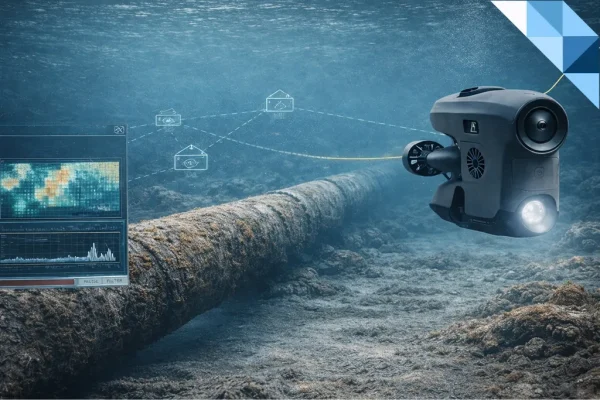

Use AUV/MBES corridor surveys to map the full pipeline route and systematically identify free-spans and seabed exposures. Each anomaly is tagged with UTC time, coordinates, and chainage, then revisited selectively using ROV visual inspection (CVI) and targeted UT/CP measurements only when engineering decisions require verified numbers.
The result is a Class-ready span and exposure register with scaled evidence, time-coded media, and traceable calibration records that can feed directly into integrity decisions and interval updates under Risk-Based Inspection (RBI).
Why Free-Spans and Exposures Matter in Pipeline Integrity
Subsea pipelines do not usually fail uniformly along their length. Failures concentrate where geometry, seabed interaction, and loading change—specifically at unsupported free-spans, exposed sections, and recurring scour zones.
Free-spans introduce vibration and bending stresses, while exposure increases vulnerability to impact, fatigue, and external interference. Seasonal seabed mobility means that even previously accepted conditions can reappear.
The most effective control strategy is not inspecting everything up close, but (1) seeing the entire corridor once, and (2) returning only to locations that drive engineering or integrity decisions.
This is the AUV → ROV inspection model: wide-area corridor mapping at scale, followed by decision-grade close-in inspection that surveyors and Class can accept. If you want the method-versus-deliverable mapping for subsea workscopes (what each modality can prove, and what it cannot), align this workflow with Underwater Inspection (ROV) under Inspection Services.
For readers building a complete package, the surrounding playbooks that connect directly to this workflow are:
- Low-visibility coverage proof: Low-Visibility Playbook: Multibeam & Imaging Sonar as Coverage Evidence
- Repeatable close-in measurements: ROV-Deployed NDT in Practice: UT & CP That Deliver Repeatable, Class-Ready Results
- Evidence processing at scale: AI-Assisted ROV Inspection: From 4K & Sonar Streams to Class-Ready Evidence
- Dimensional confidence where acceptance depends on uncertainty control: Subsea Photogrammetry & Digital Twins: Scale Control, Pass Design, Uncertainty & Class Acceptance
AUV / MBES Corridor Design: See the Whole Pipeline Once
Objective
Achieve auditable corridor coverage with documented overlap and navigation confidence, so the anomaly shortlist is defensible.
Track Planning
- Lane strategy: primary centerline track, supplemented by cross-lines at bends, crossings, tees, and known scour fields. Increase overlap to 20–30% in complex terrain.
- Altitude and speed: maintain constant altitude matched to beam footprint; stable speed prevents density banding and stitching errors.
- Navigation: INS/DVL as standard, with USBL (or equivalent) corrections where available. Publish a navigation confidence statement per segment.
- Cross-checks: insert short repeat passes (“check segments”) every few kilometers to bound accumulated drift.
Mosaic and Quality Control
- Report overlap percentage, residuals at overlaps, masked area percentage, and how multipath/shadow zones were handled.
- Include a confidence layer to prevent over-interpretation of weak data.
- Synchronize all systems to UTC and log offsets per shift to streamline ROV revisit planning.
Hit Tagging: Turning Sonar Data into a Decision List
Each detected feature becomes a decision-oriented waypoint:
- ID and anomaly type: free-span, exposure, debris contact, curvature anomaly, mattress displacement, crossing disturbance
- Location data: coordinates, KP/chainage, water depth, seabed slope/bedform
- Confidence score and mosaic thumbnail
- Planned revisit method: ROV CVI, UT thickness, and/or CP verification
- Priority (P1–P3) with the expected decision: monitor, mitigate, or repair
When this list is built correctly, field time stays focused on “decision points” rather than blanket revisits, and the final register becomes easier to review and approve.
ROV Revisit: Context First, Numbers When Required
CVI: Visual Evidence That Holds Up
- Framing: steady approach; show the pipe from both shoulders of the span; add orthogonal passes to remove perspective bias.
- Scale: dual laser dots visible in key frames; short time-coded clips with UTC overlay (or a clean time-coded index tied to the media).
- Environment: record visibility, current, standoff, and lighting angles; use angled fill lighting to reduce glare on coated surfaces.
UT Thickness: When Engineering Decisions Need Numbers
- Surface preparation: minimal, localized cleaning; confirm couplant behavior underwater.
- Stability: use fixtures or crawlers where possible; use manipulators only when geometry requires.
- Calibration and velocity: record calibration block IDs at start/end and after resets; correct velocity for material and coating stack; state repeatability.
- Data deliverables: CSV with IDs, coordinates, timestamps, thickness values, probe ID, plus one scaled still per point.
If you need UT/CP outputs that remain trendable (instead of becoming isolated numbers that cannot be defended later), keep the same repeatability controls described in ROV-Deployed NDT in Practice: UT & CP That Deliver Repeatable, Class-Ready Results.
CP Checks Near Anodes and Hot Spots
- Remote mapping (if available) to visualize gradients; contact readings for confirmation.
- Show electrode placement on frame; record stabilization time and water temperature.
- Reconcile remote and contact values in a concise comparison table.
Acceptance: What a Class-Ready Span Register Must Demonstrate
A Class-friendly span register is concise, consistent, and traceable with minimal back-and-forth.
Recommended Fields
- Span/Exposure ID, KP/chainage, coordinates, water depth
- Span length and mid-span standoff (or exposure height)
- Soil type and nearby anode status
- Evidence links: scaled stills, time-coded CVI clips, UT/CP records where applicable
- Decision: monitor, mitigation (grout bags, supports, reburial), or repair
- Reference drawings/models and owner acceptance criteria
- Notes on currents, fishing marks, crossings, protection systems, and repeat scour history
Quality Markers Surveyors Look For
- Clear UTC timestamps on all media
- Laser scale visible in at least one orthogonal frame
- UT repeatability statistics and calibration IDs
- Transparent linkage from sonar detection → ROV evidence → final decision
If your register is meant to drive engineering disposition and long-term integrity planning, route the outputs into Pipeline Integrity Assessment so spans and exposures translate into governed decisions—not just a list of observations.
Free-Span Mechanics: Measuring What Actually Matters
- Primary drivers: vortex-induced vibration (VIV), self-weight bending, trawl interaction, seabed migration.
- Practical sizing: measure span length and mid-span standoff with scale; record pipe OD, coating type/weight, water depth, and prevailing currents.
- Decision cues: long, shallow spans may be as critical as short, high ones if resonance conditions exist.
- Evidence expectation: at least two views plus an orthogonal check; apply UT only where visual cues or criteria justify numeric confirmation.
Exposure and Reburial Logic
- Exposure risks: impact, fatigue at shoulders, CP performance changes, fishing-gear interaction.
- Class-ready proof: scaled frames across exposed length, soil description, nearby protection status (mattress/rock), and CP readings where required.
- Mitigation triggers: exposure above owner thresholds, repeated seasonal re-exposure, proximity to crossings or mobile seabeds.
When exposures are used to justify interval changes or scope reductions, keep the decision chain explicit. This is where Risk-Based Inspection (RBI) and integrity governance under Asset Integrity Management help prevent interpretation drift between campaigns.
Reporting That Operations Can Act On
Minimum Report Package
- Executive summary with span and exposure counts by severity
- Span/Exposure register (CSV/XLSX + readable PDF table)
- Coverage map showing AUV and ROV tracks
- Media index with stable filenames
- Calibration and UTC synchronization records
- Exception list with mitigation recommendations
A clean report package reduces rework because each anomaly carries its proof. If you need the execution plus the packaging to be acceptance-grade on first review, align the scope and deliverables with Underwater Inspection (ROV) via Inspection Services.
Low-Visibility Tactics That Still Deliver Confidence
In turbidity or energetic flows, sonar provides coverage proof. Tag hits precisely, add cross-lanes near structures, avoid over-smoothed mosaics, and pair each sonar hit with optical CVI, adding UT or CP only where justified. Store each pair as a single anomaly record.
For a playbook designed specifically for poor optics and auditability, see Low-Visibility Playbook: Multibeam & Imaging Sonar as Coverage Evidence.
RBI: From Findings to Inspection Intervals
- Conservative baselines where historical scour or trawling exists
- Evidence-led interval extensions where spans remain stable
- Special inspections after storms, trawl incidents, or nearby construction
- Track KPIs: P1 count, exposure exceedance, repeat scour zones, mitigation backlog
To connect subsea evidence (what you can prove) to interval decisions (what you are allowed to justify), use Risk-Based Inspection (RBI) within the wider governance of Asset Integrity Management.
AUV → ROV Pipeline Inspection Flow
Step: AUV/MBES corridor
What you do: Plan lanes, overlap, navigation confidence
Evidence you keep: Mosaic with residuals, confidence layer, UTC log
Step: Hit tagging
What you do: Classify spans and exposures
Evidence you keep: Waypoint list with thumbnails
Step: ROV CVI
What you do: Orthogonal passes, laser scale, time-coded clips
Evidence you keep: Scaled frames and clips
Step: Targeted NDT
What you do: UT/CP where numbers matter
Evidence you keep: CSV logs, calibration IDs
Step: Register and report
What you do: Single span/exposure register
Evidence you keep: PDF + CSV/XLSX, media index
Step: RBI update
What you do: Adjust intervals and triggers
Evidence you keep: Decision note with traceable inputs
FAQs
How long should a free-span be before action is required?
Use owner or Class criteria, but do not judge by length alone. Combine span length, mid-span standoff, pipe OD, coating weight, water depth, and currents.
Can sonar alone be used to accept coverage?
Yes, for coverage proof. Provide overlap, residuals, UTC sync, and confidence layers. Decisions require paired CVI evidence.
What makes a span register “Class-ready”?
Stable IDs, KP/coordinates, scaled imagery, time-coded clips, and traceable UT/CP data where numbers are used.
When is UT mandatory on exposures?
When visual evidence suggests metal-loss risk, when owner criteria require numeric trending, or when supporting interval extensions.
How do we avoid endless revisits in mobile seabeds?
Treat scour as seasonal. Re-map with AUV after major events and revisit only changed KP sections with ROV.
See the Whole Line. Decide Faster.
We combine AUV corridor mapping with targeted ROV CVI and UT/CP, delivering a span register surveyors and Class can accept on the first review. If you want this workflow executed with acceptance-grade deliverables and traceable evidence packaging, start with Underwater Inspection (ROV) and align the overall scope through Inspection Services.


2 Responses
This is the first article I’ve read that explains AUV→ROV handover without fluff. Do you have a rule of thumb for when you’d skip AUV and go straight to ROV (besides budget)? Currents/visibility thresholds?
Nice, but I think the risk framing could be stronger around trawl/anchor interaction vs free-span priorities. In the Baltic we see ‘mechanical threat first, corrosion second’ depending on route history—might be worth a sentence.