
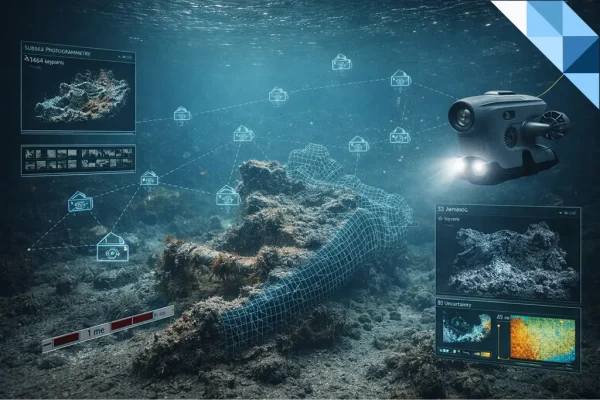

Underwater photogrammetry is accepted by Class only when it is measurable, traceable, and repeatable. Scale control (dual lasers or targets), camera geometry (overlap and angle diversity), lighting discipline, and data traceability (UTC timecode, EXIF, capture logs) define whether a 3D model is decision-grade evidence or just a visual aid.
To be accepted, a subsea digital twin must support repair decisions, monitoring, or Risk-Based Inspection (RBI) re-ranking—not marketing visuals.
Why Decision-Grade 3D Matters (Not “Pretty Pictures”)
Photogrammetry becomes valuable only when it answers a question:
- Can we repair or monitor?
- Is clearance acceptable?
- Has geometry changed since the last campaign?
- Can this evidence support RBI or Fitness-for-Service (FFS) decisions?
Class acceptance depends on whether the model is:
- Scaled
- Quantified
- Traceable to raw media
- Clear about uncertainty
For evidence expectations and inspection deliverables, see Fixed Offshore Structures: Underwater Inspection Requirements under ISO 19902 (2020).
For optics, lasers, camera mounting, and payload envelopes, refer to Underwater Inspection (ROV) under Inspection Services.
Typical Use Cases for Subsea Photogrammetry
Impact & Dent Mapping
- Quantify dent depth and extent
- Measure proximity to welds, stiffeners, or stress concentrators
Jacket Nodes & Braces
- Weld-toe and HAZ geometry visualization
- Basis for crack screening routes and future change detection
Sea-Chests & Gratings
- Confirm geometry, clearances, and fouling distribution
- Support maintenance planning before isolation
Clamps & Retrofits (As-Installed Verification)
- Dimensional proof to close non-conformities
- Confirm alignment and tolerances
Scour & Seabed Features
- Repeatable surface models around foundations
- Monitoring seabed migration over time
Each use case must clearly state:
- What decision the 3D supports
- What tolerance that decision requires
Capture Recipe: Overlap, Angles & Lighting Discipline
Stability always comes first. Smooth, repeatable motion beats fast coverage.
Minimum Capture Targets (Typical)
- Overlap:
≥70% forward, ≥60% side
(increase to 80% / 70% for complex geometry) - Angle diversity:
At least one orthogonal pass plus one oblique pass per feature - Standoff:
Stay inside the lens sweet spot; avoid focus hunting - Lighting:
Main + angled fill to reveal weld toes and reduce specular glare - Motion cues:
Short hover shots at critical features (especially pre/post cleaning)
If turbidity increases, pause optical capture, use sonar for coverage proof, and return later for optical recapture.
(For the full coverage-evidence workflow in turbidity, see Low-Visibility Playbook: Multibeam & Imaging Sonar as Coverage Evidence.)
Scale Control: Dual Lasers, Targets & Orthogonal Passes
Scale is what separates evidence from illustration.
Dual-Laser References
- Keep dot separation calibrated and visible across the area of interest
- Log laser spacing and calibration validity
- Ensure laser frames are retained and not rejected by the solver
Rigid Targets (When Feasible)
- Use coded or high-contrast targets, or known-dimension references
- Improve bundle adjustment on feature-poor surfaces
Orthogonal Passes
- Capture at least one pass perpendicular to the feature’s main axis
- Limits perspective bias and distortion
If lasers or targets are planned on an ROV, confirm mounting and payload options in Underwater Inspection (ROV).
Quality Control (QC): Making Uncertainty Explicit
Surveyors trust models when QC is published—not implied.
QC Elements to Report
- Reprojection error:
Mean and 95th-percentile (pixels)
Include a rule-of-thumb px → mm conversion at stated standoff - Control-point residuals:
Mean ± SD for any placed targets - Check-shots:
Independent measurements on known features away from targets - Masked frames:
Declare exclusions due to turbidity, glare, or motion blur - Change-detection policy:
Identical capture paths, lighting, and standoff between campaigns
Report alignment error before claiming growth or movement
A short, honest QC table beats pages of screenshots.
Reporting Pack: What Reviewers Need to Accept 3D
Deliverables must allow a third party to reach the same conclusion.
Minimum Decision-Grade Pack
- 3D assets: OBJ / PLY (or glTF) with texture files and coordinate notes
- Key stills: Annotated, dual-laser visible on critical surfaces
- Video clips: Short, time-coded segments used to extract stills
- Uncertainty table: Tolerance bands per region
(e.g. ±1.5–2.0 mm on flat plates at ~0.8 m standoff) - Capture log: Standoff, lighting, camera settings, UTC sync method
- Exceptions list: Areas where confidence is limited—explicitly stated
For broader dossier structure, refer again to Fixed Offshore Structures: Underwater Inspection Requirements under ISO 19902 (2020).
When Class Accepts 3D (and When It Won’t)
Accepted When
- Scale control is demonstrated (lasers/targets + check-shots)
- QC metrics are explicit and published
- Frames and videos are time-coded and traceable
- Findings link directly to actions (monitor / repair) and component IDs
Declined When
- No visible scale or undocumented laser spacing
- Over-smoothed meshes hide geometry
- No raw stills or video for verification
- QC missing or capture inconsistent between campaigns
Never make the surveyor guess—state the acceptance bar clearly.
Feeding Photogrammetry into RBI & FFS
Photogrammetry creates value when it reduces uncertainty.
Integration Logic
- Mechanism link:
Geometry tied to corrosion, fatigue, impact, or scour mechanisms - Quantitative inputs:
Clearances, dent geometry, volume loss feeding FFS or RBI - Escalate / De-escalate:
Stability → interval extension
Growth → special inspection - Audit trail:
Model → stills/video → capture log → decision
For decision workflows, link to Risk-Based Inspection (RBI) (inspection intervals, triggers, and audit trail) and Fitness-for-Service (FFS) (run/repair/replace logic).
Practical Field Rules (Proven in Operations)
- Clean smart: brief clean before and after where weld geometry matters
- Control blur: adjust shutter or reduce speed in currents
- Avoid flare: angle fill lighting off the weld toe
- Segment models by decision zones (node, brace, sea-chest)
- Preserve masters: avoid lossy transcode cascades; store hashes
Photogrammetry Quality Targets
| Parameter | Decision-Grade Target | Notes |
|---|---|---|
| Overlap (forward / side) | ≥70% / ≥60% (80% / 70% for complex geometry) | Robust tie points |
| Angle diversity | Orthogonal + oblique passes | Limits bias |
| Laser scale | Dual dots visible in key frames | Log spacing & calibration |
| Lighting | Main + angled fill | Avoid weld glare |
| Reprojection error | Mean & P95 (px) reported | Map px → mm at stated standoff |
| Check-shots | ≥1 per AOI | Confirms scale |
| Time-sync | UTC + EXIF consistent | Traceability |
FAQs
Is photogrammetry acceptable as the only evidence?
Yes—if it is measurable: visible scale, explicit QC, time-coded media, and a stated uncertainty table. Add NDT only when sizing beyond optical is required (see Advanced & Conventional NDT).
How much overlap is enough?
Start at ≥70% forward and ≥60% side. Increase for complex welds, nodes, or reflective surfaces.
Do we need targets if we already use lasers?
Often no. Targets help on large or feature-poor surfaces and improve solver stability.
What breaks acceptance most often?
Missing scale, missing QC, over-smoothed meshes, and inconsistent capture between campaigns.
How do we prove change between campaigns?
Replicate paths, angles, standoff, and lighting; report alignment error; include like-for-like stills with visible lasers.
Commission a Measurable 3D Package
If you need 3D that supports decisions, not presentations, we deliver scale-controlled capture, documented QC, and a traceable evidence pack your surveyor can audit.
Book Underwater Inspection (ROV) via Inspection Services.